
This article was published in Scientific American’s former blog network and reflects the views of the author, not necessarily those of Scientific American
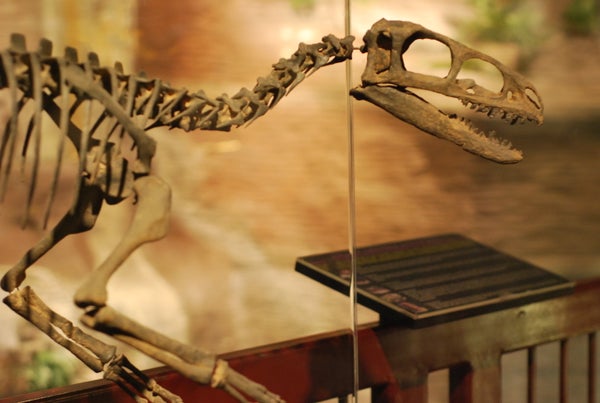
The dinosaur is known by many names. Littletooth. The Smiling Face. The Coyote of the Cretaceous. When I took a road trip down to the Arizona Museum of Natural History in the fall of 2011, though, I only knew the diminutive biter as “the Zuni coelurosaur.” I wondered if it was any relation to “Zunityrannus,” a boxy-headed but as-yet unnamed dinosaur that stalked ancient New Mexico in the BBC series Planet Dinosaur. The two didn’t look very much like each other, which only made me wonder just what the collection of bones in the glass case might be. Now the official announcement has been made. The brown skeleton, with its long arms and shallow, snappy snout, has been officially unveiled as Suskityrannus hazelae – a tyrannosaur that trotted around the ancient Zuni Basin before the rise of giant, bonecrushing tyrannosaurs later in the Cretaceous.
Suskityrannus, named by Sterling Nesbitt and eight coauthors, took a long road to stepping into the scientific spotlight. In 1997, picking over a site discovered by Douglas Wolfe and his family the previous year, Robert Denton and Brian Anderson found the bones of a coyote-sized theropod dinosaur in the 92 million-year-old rock. The remains included a partial skull. The following year, Nesbitt found an even better specimen that helped fill out the dinosaur’s anatomy.
These bones weren’t the only dinosaur remains found in this place. The horned dinosaur Zuniceratops, the sloth-like therizinosaur Nothronychus, and the hadrosaur Jeyawati all come from this area, called the Moreno Hill Formation. Together they offer a window into a little-understood time in dinosaurian evolution.
On supporting science journalism
If you're enjoying this article, consider supporting our award-winning journalism by subscribing. By purchasing a subscription you are helping to ensure the future of impactful stories about the discoveries and ideas shaping our world today.
Paleontologists have been assembling increasingly complete views of dinosaur life during the early part of the Cretaceous, about 125 million years ago. Likewise, finds in the 75 to 66 million year span include celebrities like Tyrannosaurus and Triceratops. But what was going on in between? How did horned dinosaurs, tyrannosaurs, hadrosaurs, ankylosaurs, and their neighbors go from bit players to some of the dominant dinosaurs of the Late Cretaceous? Along with other recent finds in Utah and New Mexico, the Moreno Hill dinosaurs help fill in the picture.
The newly-named dinosaur’s title provides a rough picture of its role in its ancient ecosystem. “Suski” is the Zuni word for coyote, which the paleontologists chose after consultation with the Pueblo of the Zuni Tribal Council. And “tyrannus,” of course, means king, making Suskityrannus the coyote king. The dinosaur was about the same size as the modern mammalian carnivore, and, in its Cretaceous time, it probably pounced on relatively small prey much like modern coyotes do.
In the dinosaur family tree, Suskityrannus is a tyrannosauroid. This is the broader group to which all tyrannosaurs belong, but the term is usually used in reference to relatively early or archaic tyrannosaurs. And Suskityrannus is just one of several new tyrannosaurs named just this year. Moros, from the 96 million-year-old strata of Utah, is a little older than Suskityrannus, and the roughly 78 million-year-old Dynamoterror is younger. There are still gaps to fill, but the signal that starts to come through is that tyrannosaurs were pipsqueaks in North America from 150 million years ago until at least 92 million years ago. For most of their history - over 50 million years - North American tyrannosaurs lived in the shadow of other carnivores. The great tyrannosaur takeover happened sometime between the days of Suskityrannus and Dynamoterror, giving paleontologists a new timespan to search for answers.
This isn’t just about tyrannosaurs, though. The Moreno Hill Formation has yielded an entire community of dinosaurs. There are small tyrannosaurs, small horned dinosaurs, and small hadrosaurs, but Nesbitt and colleagues also note that this slice of time is significant for what’s missing. There are no long-necked sauropod dinosaurs, no huge allosaurs, and no close relatives of Iguanodon that were very common earlier in the Cretaceous. The dinosaurs from the Zuni Basin therefore represent a turning point in dinosaur history. The dinosaur fauna that became established in the Late Jurassic and persisted through the Early Cretaceous had been shaken up, relatively small and seemingly marginal species now stepping to the fore. Suskityrannus and its relatives set the stage for great things that were soon to come.