
This article was published in Scientific American’s former blog network and reflects the views of the author, not necessarily those of Scientific American
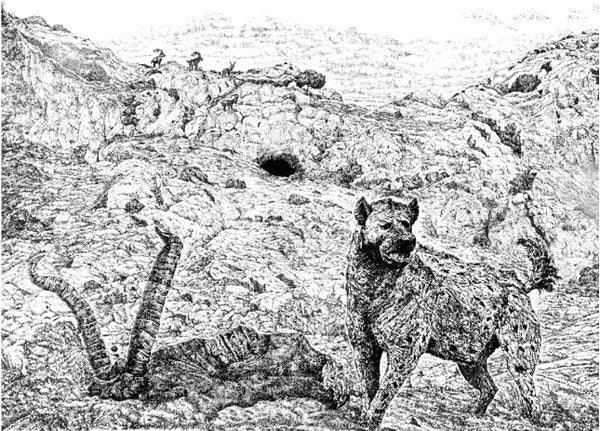
The Ice Age conjures visions of beasts long gone: the mammoths and mastodons, sharp-fanged sabercats, giant ground sloths, and other beasts that fill the ranks of Earth’s dead zoo. But not every inhabitant of the Ice Age world would have looked strange or unusual to our modern eyes. Consider the cave hyena.
Today’s spotted hyenas – Crocuta crocuta – are savanna celebrities. No African safari is complete without hearing their giggles and woops. But in the not-so-distant past, these charismatic carnivores had a subspecies that ranged across Eurasia. This was the cave hyena, Crocuta crocuta spelaea, and paleontologists have recently uncovered the best skeleton of this bone-crusher yet found on the Iberian Peninsula.
The partial skeleton was found at Los Aprendices Cave, a 143,000-38,000 year old site in northern Spain. The remains of several other mammals were found at the site, including ibex, rabbit, rodent, and desman, but, as Victor Sauqué and colleagues write on their report of the cave, the hyena bones are most remarkable of all.
Despite the fact that cave hyenas were relatively common in Ice Age Europe, their skeletons are considered rare. Their bones were often broken and scattered, sometimes because the living hyenas scavenged the dead. So even though previous research has revealed that the form of this ancient mammal was similar to that of today’s spotted hyena, any new cave hyena skeleton offers a new point of comparison between the present and not-too-distant past.

The skeleton of the Los Aprendices hyena. Credit: Sauqué et al 2017
This particular hyena, Sauqué and coauthors write, is represented by 194 bones. That’s not bad at all, with the skull and limbs almost completely represented. And from those bones, the researchers estimated that this individual weighed about 227 pounds – quite a bit heftier than most spotted hyenas alive today. In fact, Sauqué and colleagues write, the cave hyena was “a heavier and more powerful animal” than its living relatives. A stockier build would have made it less skilled as a runner, but better able to drag large portions of carcasses back to dens to consume in relative peace.
So was the Los Aprendices hyena just like a bulkier spotted hyena? That’s difficult to say. Ice Age cave hyenas and today’s spotted hyenas were close relatives, with some experts allocating the cave hyenas to a subspecies of spotted hyena. Yet Sauqué and colleagues point out differences in size, jaw anatomy, and possibly behavior that might separate the two forms.
Cave hyenas are thought to have been major bone accumulators during the Ice Age whereas today’s spotted hyenas don’t engage in the behavior nearly as often. A recent study on fossil hyena brains, likewise, suggest that the smarts of today’s spotted hyenas was a relatively recent evolutionary event and may have further distinguished today’s populations from the cave hyenas. Regardless of how the systematics shake out, however, Europe’s Ice Age hyenas were undoubtedly impressive beasts, and we can thank them for helping to create a record of Pleistocene life through their leftovers.
On supporting science journalism
If you're enjoying this article, consider supporting our award-winning journalism by subscribing. By purchasing a subscription you are helping to ensure the future of impactful stories about the discoveries and ideas shaping our world today.
Reference:
Sauqué, V., Rabal-Garcés, R., Madurell-Malaperia, J., Gisbert, M., Zamora, S., de Torres, T., Ortiz, J., Cuenca-Bescós, G. 2017. Pleistocene cave hyenas in the Iberian Peninsula: new insights from Los Aprendices cave (Moncayo, Zaragoza). Palaeontogia Electronica. 20.1.11A: 1-38