
This article was published in Scientific American’s former blog network and reflects the views of the author, not necessarily those of Scientific American
Jurassic Park sticks with me for plenty of reasons. The dinosaurs, of course, were the major draw when I picked up the novel in advance of the screen adaptation’s summer 1993 release. It was also the first “grown up book” I was allowed to read. And then there was the scene where the Tyrannosaurus wraps its prehensile tongue around Tim’s head, a narcotic sleep being the only thing that saves the kid. As much as I adored dinosaurs, I didn’t relish the image of being drawn, helpless, towards the jaws of one of my Mesozoic favorites.
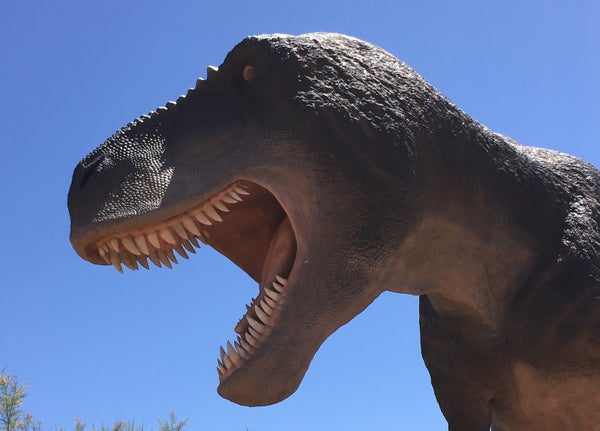
A new paper on the anatomy of dinosaur tongues reminded me of that creepy scene. Chalk up another difference between the world of Jurassic Park and actual dinosaurs - T. rex actually had a very different tongue.
No one, as yet, has found a preserved non-avian dinosaur tongue or tongue impression. But that doesn’t mean that the anatomical trail has run cold. There are bony correlates to tongue size and anatomy that paleontologists can look at for soft tissue clues. As part of a study on dinosaur tongues, paleontologists Zhiheng Li, Zhonghe Zhou, and Julia Clarke looked at one of these - the hyoid bone.
On supporting science journalism
If you're enjoying this article, consider supporting our award-winning journalism by subscribing. By purchasing a subscription you are helping to ensure the future of impactful stories about the discoveries and ideas shaping our world today.
You have a hyoid. It’s a U-shaped bone that’s sitting in your throat, hidden between your neck vertebrae and your lower jaw. (Next time you see an anatomical skeleton in a classroom or doctor’s office, have a look up there.) Among other functions, it’s an essential anchor point for the tongue. So, given that non-avian dinosaurs and their relatives had hyoid bones, too, Li and colleagues were able to trace the structure's anatomy across species to see what those differences say about tongue anatomy.
What the researchers found might come as a surprise. Non-avian dinosaurs were incredibly disparate in body types - Tyrannosaurus, Triceratops, Brontosaurus, Parasaurolophus, and Velociraptor were all dinosaurs despite their obvious differences in shape and size. When it comes to hyoids, though, the researchers found that non-avian dinosaurs generally had simple hyoid bones that don’t suggest any particular “elaboration” of the tongue. In fact, the only dinosaurs that seem to have had more elaborate hyoids - and therefore tongues capable of more movement - were the plant-chomping ornithischian dinosaurs and flying species.
So what does this mean for the tongue of T. rex? Well, the sort of features related to extra tongue mobility and the ability to stick out the tongue were absent from the dinosaurs in the study most closely related to the tyrant king. Most non-avian dinosaurs, then, probably had relatively simple, flat tongues like those in the mouths of today’s alligators and crocodiles. The shovel-beaked hadrosaurs and the armored ankylosaurs may have had more elaborate tongues - the better to help them cram plants into their mouths - and early birds began to get more elaborate tongue apparatus, but it seems most non-avian dinosaurs would have been incapable of giving you a Bronx cheer.
For more, you can follow my work on Patreon, Twitter, and Instagram.
