
This article was published in Scientific American’s former blog network and reflects the views of the author, not necessarily those of Scientific American
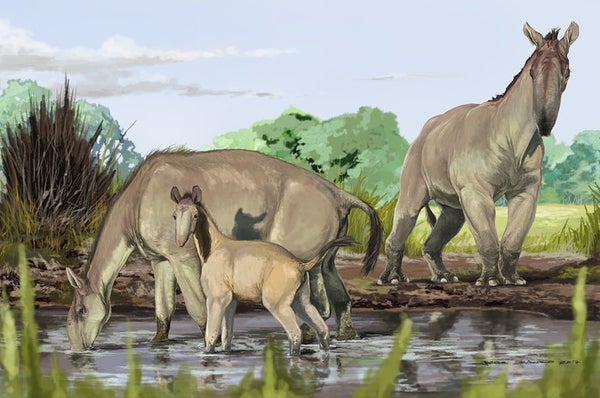
For an animal that’s been dead since the close of the Ice Age, Macrauchenia has been awfully stubborn. For over a century and a half, paleontologists have been trying to figure how this camel-like beast fits into the wider mammal family tree. Now, with the help of some ancient DNA, the experts have an answer.
Way back in 1838, while poking around for fossils near Puerto San Julian in Patagonia, a young Charles Darwin found some odd bones. He thought that they might belong to some sort of prehistoric llama. Those remains, later analyzed by Richard Owen – Britain’s foremost anatomist at the time – were given the name Macrauchenia patachonica. It wasn’t quite like anything anyone had seen before. The proportions were llama-like, as Darwin has expected, but it didn’t seem to fit in with any living group of mammals.
More fossils only made Macrauchenia stranger. A nasal opening high on the skull implied a tapir-like trunk hanging off the herbivore’s face, and paleontologists eventually categorized the mammal as a litoptern – an unusual group of South American mammals with a fossil record spanning from just after the demise of the non-avian dinosaurs to the close of the Pleistocene. It was perhaps the chief example of enigmatic South American native ungulates – SANUs – that superficially resembled beasts from elsewhere but had evolved independently. How do you categorize horses that aren't horses and elephants that aren't elephants?
On supporting science journalism
If you're enjoying this article, consider supporting our award-winning journalism by subscribing. By purchasing a subscription you are helping to ensure the future of impactful stories about the discoveries and ideas shaping our world today.

Locations of sampled Macrauchenia. Credit: Westbury et al 2017
Start from any twig on the tree of life and you should be able to follow that back through the tangle of branches to find common ancestry and the unfolding of evolutionary changes. In the case of Macrauchenia, however, the bones alone weren’t getting paleontologists very far. Different analyses popped the herbivore out on various places in the mammal family tree. South America’s “splendid isolation” led to the evolution of some truly confounding mammals.
Here’s where the new study by geneticst Michael Westbury and colleagues comes in. Even though previous attempts to gather genetic tidbits from Macrauchenia bones failed, a new approach and subsequent analysis assembled a nearly complete mitochondrial genome for the fossil mammal. And with this new information, they were finally able to find a place for Macrauchenia.
In the resulting tree, Macrauchenia and its litoptern relatives came out as the sister taxon to perissodactyls. Or, in other words, one branch over from the larger group that contains rhinos, tapirs, horses, and their closest relatives. More than that, Westbury and coauthors report, these two lineages split from each other about 66 million years ago, right at the beginning of the Age of Mammals. Darwin’s mystery mammal was one of the last remaining members of a group that first sprung up right after the likes of Triceratops was swept off the scene, another example of how catastrophic extinction opens up new evolutionary possibilities.
Reference:
Westbury, M., Baleka, S., Barlow, A., Hartmann, S., Paijmans, J., Kramarz, A., Forasiepi, A., Bond, M., Gelfo, J., Reguero, M. Mendoza, P., Taglioretti, M., Scaglia F., Rinderknecht, A., Jones, W., Mena, F., Billet, G., de Muizon, C., Aguilar, J., MacPhee, R., Hofreiter, M. 2017. A mitogenomic timetree for Darwin’s enigmatic South American mammal Macrauchenia patachonica. Nature Communications. doi: 10.1038/ncomms15951