
This article was published in Scientific American’s former blog network and reflects the views of the author, not necessarily those of Scientific American
On supporting science journalism
If you're enjoying this article, consider supporting our award-winning journalism by subscribing. By purchasing a subscription you are helping to ensure the future of impactful stories about the discoveries and ideas shaping our world today.
We still don’t know why a raven is like a writing desk, but, according to anatomist Matthew McCurry and colleagues, we know a bit about why a crocodile is like a whale.
Today’s crocodylians and toothed whales aren’t closely related at all. They last shared a common ancestor over 288 million years ago, when the forebears of reptiles and mammals parted evolutionary ways. Despite this, though, both the reptiles and mammals have jaws lined with conical teeth and a similar array of snout shapes. Despite vastly different evolutionary histories, the two groups have come to resemble each other.
This phenomenon is called convergence, and it pops up all over the tree of life. The similarity of a pterosaur’s wing to that of a bat’s, the shared, streamlined shapes of sharks and ichthyosaurs, and the repeated evolution of saberteeth in fossil mammals are all examples. The physical constraints of certain activities like flying, swimming, and biting will nudge distantly-related species to evolve into similar forms. Crocodylians and toothed whales are yet another example, but, until now, researchers hadn’t paid too much attention as to why.
To address the question, McCurry and colleagues turned to an anatomical tool called three-dimensional morphometrics. This is a way of quantifying the anatomical differences between skull shapes rather than just eyeballing resemblances. And after examining the variations between 75 mandibles and 97 crania of crocodylians and toothed whales, the anatomists were able to pin down some more specific details of this “remarkable convergence” between distantly-related vertebrates.

The skulls of a La Plata dolphin, gharial, orca, and dwarf crocodile, scaled to the same length. Credit: McCurry et al. 2017
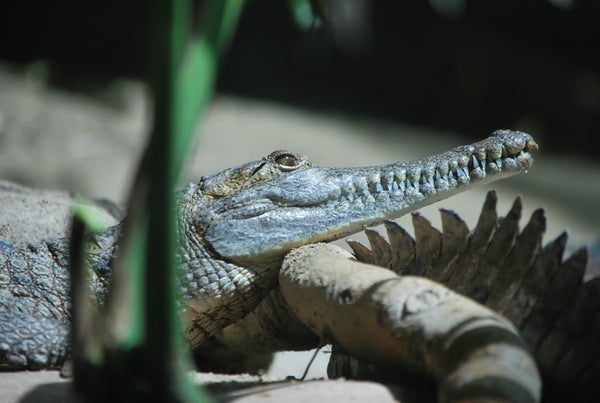
Toothed whale and crocodylian skull shapes primarily come in two flavors – brevirostrine forms with short, broad skulls and longirostrine forms with long and thin skulls. Look at the blunted snout of a dwarf crocodile and you’re seeing the same shape as an orca’s, their U-shaped, tall skulls adapted to taking a variety of prey. Most striking of all, though, were the similarities between river dolphins and gharials. Both have long, thin crania with straight snouts, for example, and slight bowing of the jaws. This is probably because both the river dolphins and gharials are riverdwellers that snap up small fish and don’t take large prey. Feeding on similar prey allowed the evolution of extremely similar skulls.
Ultimately, McCurry and coauthors found, many crocodylians look so similar to some whales because of how they feed. Species that are dietary generalists have deep, broad skulls while the riverine fish-snatchers more closely resemble each other than their actual close relatives in their respective reptilian and mammalian families. It just goes to show there’s more than one way to interpret “You are what you eat.”
Reference:
McCurry, M., Evans, A., Fitzgerald, E., Adams, J., Clausen, P., McHenry, C. 2017. The remarkable convergence of skull shape in crocodilians and toothed whales. Proceedings of the Royal Society B. doi: 10.1098/rspb.2016.2348
