
This article was published in Scientific American’s former blog network and reflects the views of the author, not necessarily those of Scientific American
Is it a sign of a true space-faring species when we start to forget what we have scattered around the solar system?
Take Mars for example. Right now we have active missions like the Mars Reconnaissance Orbiter (arrived 2006), Mars Express (arrived 2003), Mars Odyssey (arrived 2001), MAVEN (arrived 2014), Mars Orbiter Mission/Mangalyaan (arrived 2014), and the ExoMars Trace Gas Orbiter (arrived 2016) - all circling the red planet. On the ground we have the Curiosity rover (arrived 2012), and the Opportunity rover (arrived 2004). And that list doesn't include all the inactive probes from the past decades of exploration...or indeed the wreckage of some.
With such a litany of robotic avatars it's perhaps not surprising that our attention wanders.
On supporting science journalism
If you're enjoying this article, consider supporting our award-winning journalism by subscribing. By purchasing a subscription you are helping to ensure the future of impactful stories about the discoveries and ideas shaping our world today.
That last name, Opportunity, is particularly impressive. The twin Mars Exploration Rovers - renamed Spirit and Opportunity - had an original mission goal of 90 days of operation on the surface of the planet. Both rovers far, far exceeded expectations. Spirit operated until 2010 until it got stuck in the martian soil, and eventually went silent. But Opportunity is still going, having now spent a total of 150 months on Mars, covering 27 miles of terrain.
In fact, the solar-powered rover has now reached a major target in its slow trek; an ancient fluid-carved valley slicing into the inner slope of the vast Endeavour crater's rim (Endeavour is about 14 miles across). Here's a map showing the rover's route during early 2017:

Opportunity's path (heading downwards/south in image. Credit: NASA, JPL-Caltech, University of Arizona, NMMNH
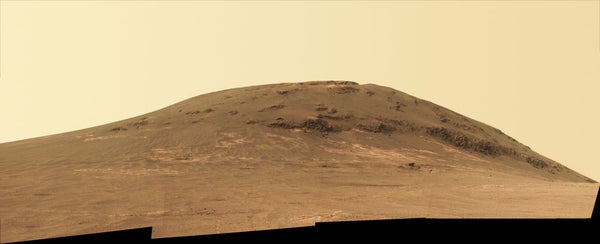
The image at the top of this blog post was taken in April 2017 as Opportunity looked back at the terrain to the north, having just trundled down from Cape Tribulation. And here's a snippet of a panoramic image looking towards the valley (Perseverance Valley) and down into Endeavour Crater:
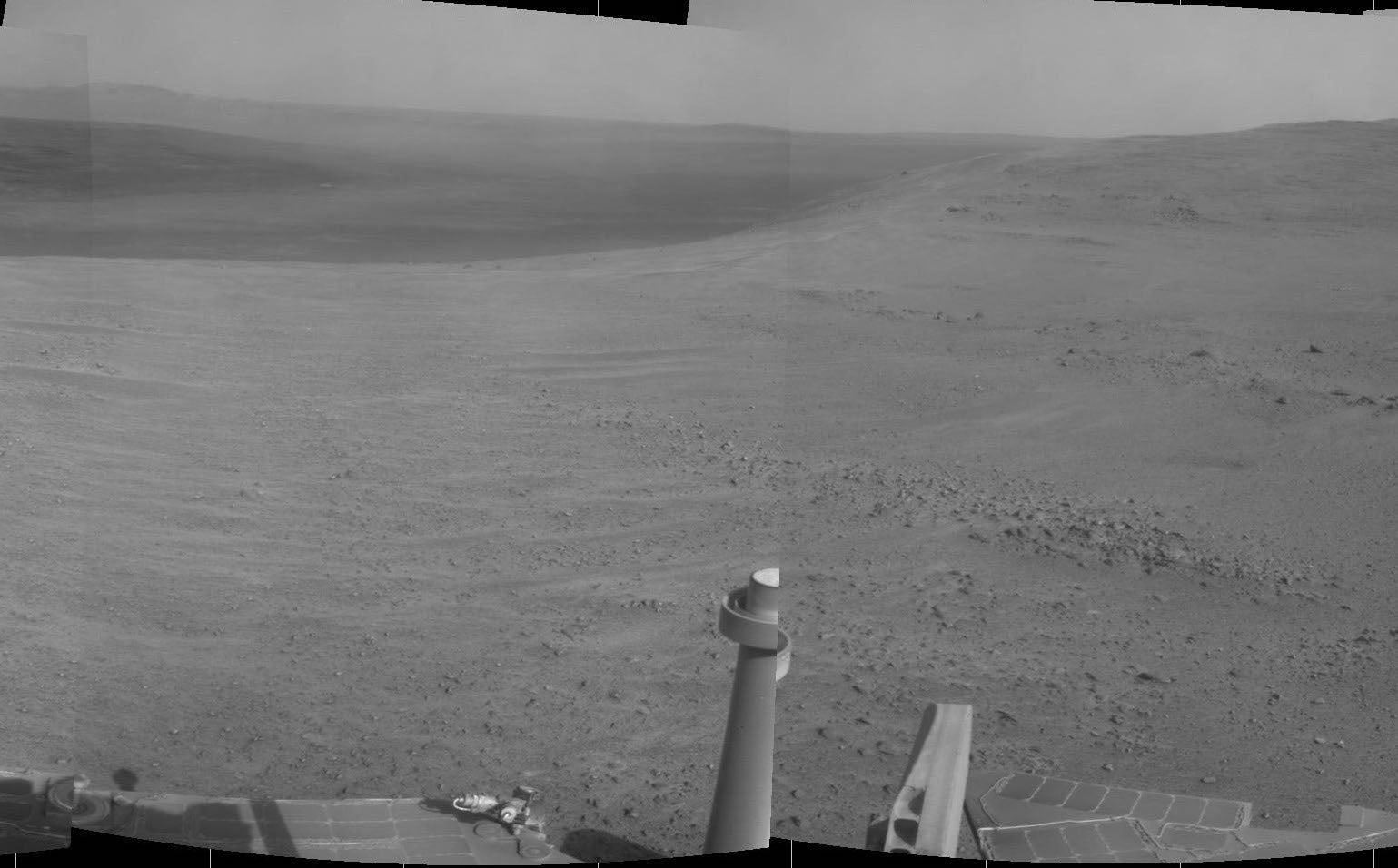
Credit: NASA, JPL-Caltech
The plan is to next drive the rover down this valley and into the crater. Along the way it will gather images and data to help planetary scientists better understand these geological formations and their implications for Mars's deep history.
Luckily, a recent windy spell has cleared off some of the dust that accumulates on Opportunity's solar panels - lifting their efficiency by about 10%. Forewarned by the Mars Reconnaissance Orbiter the rover was even able to capture this regional dust storm as it approached on February 24th 2017:

False color images taken a couple of minutes apart and then combined highlight an approaching dust storm. Credit: NASA, JPL-Caltech, Cornell, ASU
Clearly Opportunity is far from being really forgotten, but the fact that most humans do not jump out of bed in the morning thinking about what they'll be able to see on Mars that day is almost as extraordinary as the fact that our machines have made us a multi-planet species.