
This article was published in Scientific American’s former blog network and reflects the views of the author, not necessarily those of Scientific American
If there is one certain thing in space exploration it is that nature will always find new ways to surprise us.
NASA's OSIRIS-REx mission was launched in 2016 and arrived at its target, the near-Earth carbonaceous asteroid Bennu in December 2018. One of the main goals for OSIRIS-REx is a sample return. A robotic arm and sampling system will be brought into contact with the asteroid's surface and if things go according to plan a sample will be stowed and brought back to Earth in 2023.
But Bennu is already turning out to be a trickier and more interesting beast than perhaps expected. At just some 492 meters across it's a pretty small body, and OSIRIS-REx currently has the smallest orbit around Bennu of any space mission exploring a solar system body to date - at a mere 1.6 kilometers.
On supporting science journalism
If you're enjoying this article, consider supporting our award-winning journalism by subscribing. By purchasing a subscription you are helping to ensure the future of impactful stories about the discoveries and ideas shaping our world today.
Two observations from this close-in perspective stand out at this time. The first is that Bennu is extraordinarily rocky - its surface is littered with boulders, forming a rough and varied terrain that was not expected. This may prove challenging for the sample return 'touchdown' maneuver that requires a clear approach to finer grained material that can be captured.
But also, against expectations, Bennu also now appears to be 'active'. Specifically, back in January the mission scientists discovered that Bennu is producing 'plumes' of particles, or ejection events. Small pieces of material are being episodically thrown outwards from the asteroid's surface, and climbing away from its tiny gravitational pull. An image shows one such plume (combining a short exposure of the asteroid and a longer exposure of the extremely faint particles):
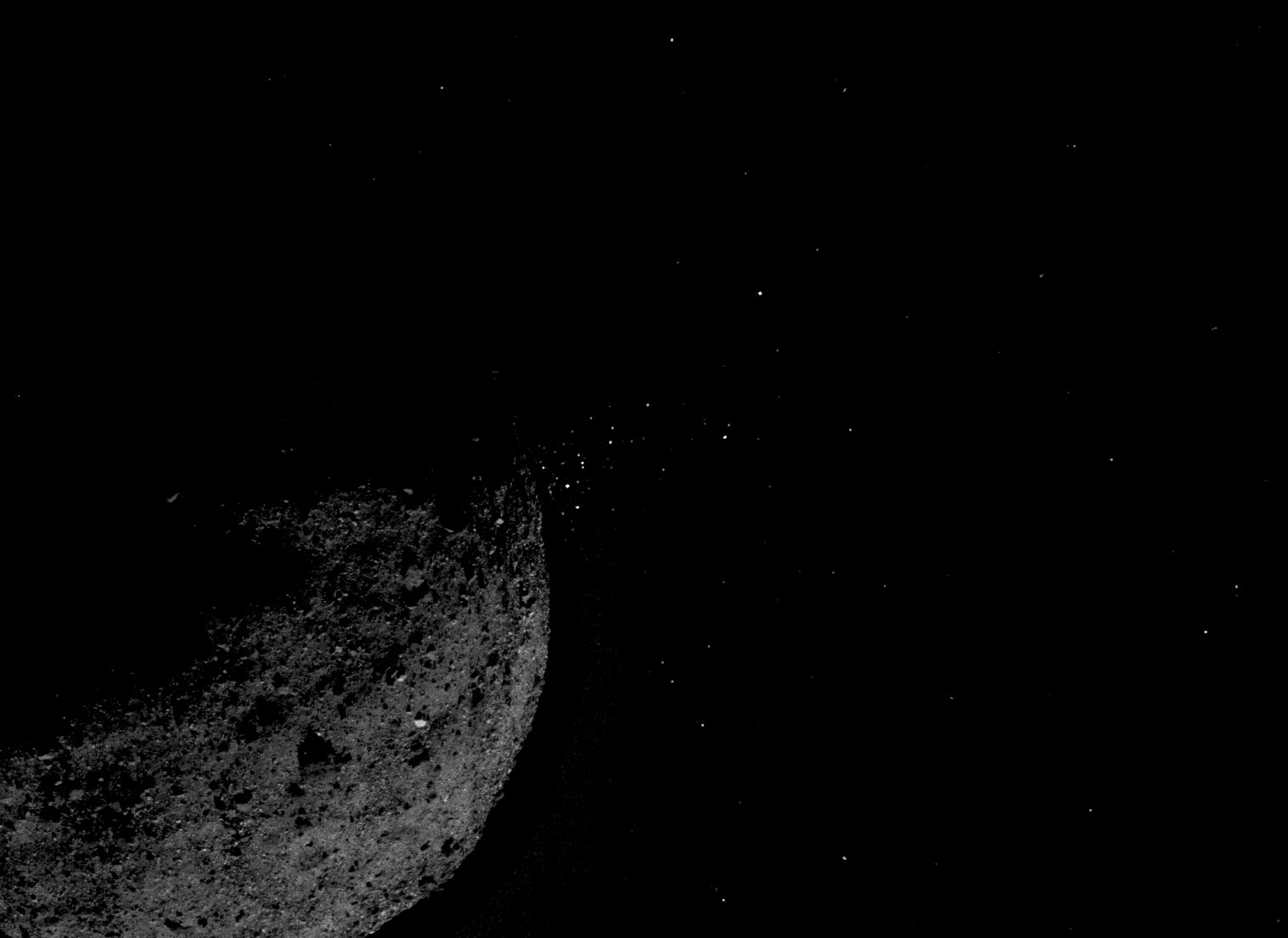
Eleven such events have been seen at this time. This places Bennu into a fairly elite club of 'active' asteroids - bodies that show evidence of ejection of material. Not all of the particles escape the asteroid, many seem likely to fall back after a period of being lofted up, implying that Bennu 'self-refreshes' its surface with pebbly matter.
What's causing these spit ups? We don't know, but it seems plausible that it's connected with heating of Bennu during part of its orbit around the Sun. For the other active asteroids in the solar system the possibilities include: impact ejection and disruption, electrostatic repulsion, rotational instabilities, radiation pressure, dehydration stresses and thermal fracture, or even the boil-off (sublimation) of asteroidal ice.
Studying this phenomenon close up is a unique, and unexpected, opportunity.