
This article was published in Scientific American’s former blog network and reflects the views of the author, not necessarily those of Scientific American
There have been a slew of fascinating results and discussions from our study and exploration of the universe around us in recent weeks. Here's a quick round up of five that are worth checking out.
Saturn's inner moons may be younger than 100 million years
Tethys, Dione and Rhea (part of Saturn's vast satellite menagerie) might have only formed within the past 100 million years or so - according to dynamical models of their orbital evolution, and the constraint from assuming that all of Enceladus's activity is driven by tidal heating.
On supporting science journalism
If you're enjoying this article, consider supporting our award-winning journalism by subscribing. By purchasing a subscription you are helping to ensure the future of impactful stories about the discoveries and ideas shaping our world today.
Could the Sun superflare?
Astronomers suggest that perhaps 10% of superflaring stars have lower magnetic activity, similar to that of the Sun. One possible implication is that our star might, sometimes, produce flare events 10,000 times more powerful than the largest recorded so far.
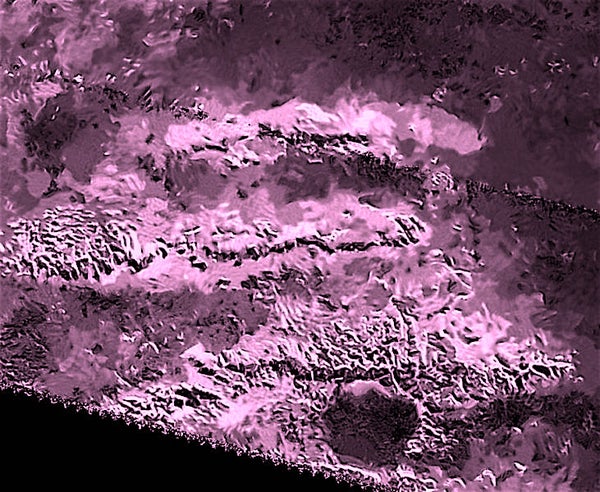
High-point on Titan identified
Data from the Cassini mission's radar instrument have revealed that the highest mountain range on Titan includes a water-ice peak hitting over 3,300 meters above the mean elevation. With an expected squishy bedrock of a water-ice mix this height suggests an active tectonic process pushing the mountain up.
Malaria and dinosaurs?
The disease malaria may have been around for 100 million years, infecting dinosaurs as well as other species. This suggest some interesting, and ancient, evolutionary dynamics between the disease carriers - insects - and large animals.
Human DNA has more viral sequences than thought
It's been well known that all species harbor a mishmash of DNA, including that inherited from ancient viral insertion. Now a new study shows that humans are even more 'viral' than thought. In fact about 50 people out of the 2,500 examined contained the genetic code for an entire virus, in their own 'human' code.