
This article was published in Scientific American’s former blog network and reflects the views of the author, not necessarily those of Scientific American
The European Space Agency's Rosetta mission has been one of the most exciting space science explorations in recent history. Launched in 2004 from the tropical coast of French Guiana it took ten years to reach its target: the comet 67P/Churyumov–Gerasimenko. In addition to depositing a bold, but only partially successful lander called Philae, the main spacecraft spent two years accumulating a remarkable dataset of imagery, spectroscopy, gas and particle composition, and radar sounding of the cometary nucleus.
The final Rosetta image archive has now been released, and there are some real gems.
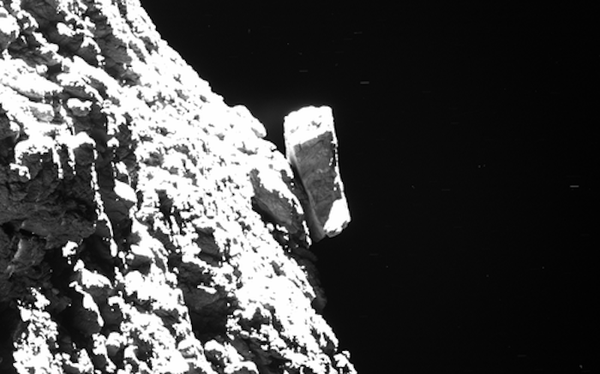
Take for example the following image. Here's a crazy looking shot across 67P's bow - with what appears to be the cometary equivalent of a 'balancing rock' (the kind of thing we see in some of Earth's wildernesses). This must be a chunk of one of the layers making up the comet with its surroundings eroded, or a display of the result of earlier tumbles and slippage. Although very weak at about 1/10,000 th of Earth's surface acceleration, 67P's gravitational field is still enough to keep material glued together - including this natural plinth.
On supporting science journalism
If you're enjoying this article, consider supporting our award-winning journalism by subscribing. By purchasing a subscription you are helping to ensure the future of impactful stories about the discoveries and ideas shaping our world today.
But there's something else here too. Lurking towards the upper left is evidence of the Philae lander, still sitting askew on the surface. It's a cosmic 'where in the world?' (or comet) challenge. The answer comes lower down.

Looking at the nucleus, image scale 4.6 cm per pixel. Credit: ESA, Rosetta, MPS for OSIRIS Team MPS, UPD, LAM, IAA, SSO, INTA, UPM, DASP and IDA (CC BY-SA 4.0)
And if you weren't able to spot the signs of Philae (not easy), here's the solution:

One of Philae's legs pokes up from its resting place. Credit:ESA, Rosetta, MPS for OSIRIS Team MPS, UPD, LAM, IAA, SSO, INTA, UPM, DASP and IDA (CC BY-SA 4.0)
Here are a couple more images drawn from the extensive online archive, including this one where the entire nucleus (seen by the wide view NAVCAM) itself looks like a balancing rock.

This one with a plume of volatiles emerging from the nucleus.
.png?w=1350)
Credit: ESA, Rosetta and NAVCAM (CC BY-SA IGO 3.0)