
This article was published in Scientific American’s former blog network and reflects the views of the author, not necessarily those of Scientific American
Humans have cataloged the star Fomalhaut for at least two thousand years without knowing it as anything more than the 18th brightest stellar object in the night sky.
But in the 21st century Fomalhaut has become a key system in the quest to understand the nature of planets and their formation. This relatively massive star (about 90% more massive than the Sun) is very young; clocking in at somewhere between 100 and 440 million years old. It's also surrounded by a set of so-called debris disks - material that represents both the detritus and building blocks of planetary objects.
In 2008 Hubble Space Telescope images yielded a tentative detection of visible light scattering off dust around a massive planet orbiting Fomalhaut approximately every 1,700 years. Subsequent data has confirmed this detection by seeing the planet move along its orbit, and suggests that it could be a few times the mass of Jupiter and is surrounded by its own circumplanetary cloud of interplanetary muck.
On supporting science journalism
If you're enjoying this article, consider supporting our award-winning journalism by subscribing. By purchasing a subscription you are helping to ensure the future of impactful stories about the discoveries and ideas shaping our world today.
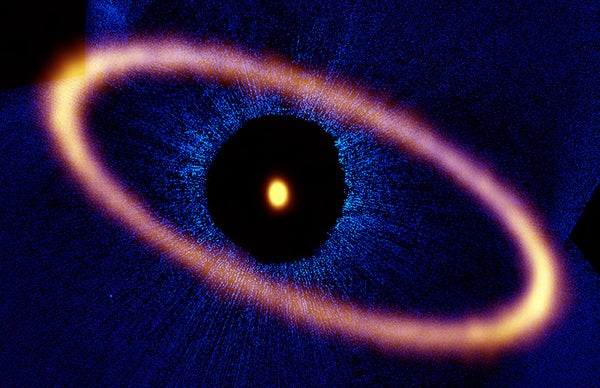
This world also orbits just inside the realm of a vast ring of dusty material, encircling the star at an average distance of about 20 billion kilometers.
Now Matrà et al. have announced that this outer ring is aglow with millimeter-wavelength radiation, the luminous tracer of carbon monoxide gas, itself a prime signpost for rich icy material circling the star.
The image, taken by the Atacama Large Millimeter/sub-millimeter Array (ALMA) is stunning:

A 20 billion kilometer radius ring of gas and icy material. Credit: ALMA (ESO, NAOJ, NRAO), M. MacGregor
The bottom line is that this 100-billion kilometer circumference ring (with a width of approximately 2 billion kilometers) is likely revealing the presence of a vast population of icy exocomets. As these objects collide with each other - either in a few massive collisions, or a stream of cascading pile-ups - some of their frozen gases are released to interplanetary space.
The researchers suggest that the mix of carbon monoxide and carbon dioxide in the Fomalhaut system is similar to that seen in cometary bodies in our own solar system. In other words, by studying Fomalhaut we might gain insights to what happened in our own deep past.
In fact, this glowing ring could be telling us that the system is experiencing a version of the Late Heavy Bombardment that is often proposed for our own solar system about 4.1 billion years ago. In this scenario the early rearrangement of giant planet orbits can disturb the orbits of smaller bodies throughout the system - causing a steady and brutal pounding of the inner planets by asteroids and cometary bodies.
At a distance of 25 light years, and with an expected hydrogen-fusing lifespan of a mere billion years, Fomalhaut is a pretty alien system, yet it may be experiencing the same planetary phenomena that helped make our own family of worlds.