
This article was published in Scientific American’s former blog network and reflects the views of the author, not necessarily those of Scientific American
The detection of a meteor fireball with an explosive energy equal to approximately 10 Hiroshima-scale nuclear bombs (the actual meteor total was equivalent to a touch over 170 kilotons of TNT) has been doing the news rounds in recent days. This event took place in December 2018, but because the atmospheric impact was over the the Bering Sea, near the Kamchatka Peninsula, there don't appear to have been any direct human witnesses at the time.
Military satellites most certainly registered the event (and we can assume, luckily, did not mistake this for something more sinister) and eventually told NASA. Some detective work has also turned up a remarkable image of the meteor plume taken by a Japanese whole-disk Earth weather satellite, Himawari-8.
Despite the power of the explosion, this object was only a few meters across. But with a 32 kilometer-a-second velocity and a steep incoming trajectory, only about 7 degrees off the vertical, it packed a kinetic energy punch when it exploded at about 25 kilometers altitude.
On supporting science journalism
If you're enjoying this article, consider supporting our award-winning journalism by subscribing. By purchasing a subscription you are helping to ensure the future of impactful stories about the discoveries and ideas shaping our world today.
Overall this object delivered only about 40% of the energy that the Chelyabinsk meteor did back in 2013. Still enough to have potentially done some damage with its shockwave if it had been over a populated area.
Statistically this was nothing unusual, between it and the Chelyabinsk event we're pretty much experiencing the expected rate of bombardment. In fact you can go and see where we're at in terms of recent hits at the Center for Near Earth Objects (CNEOS) NASA site and reproduced here.
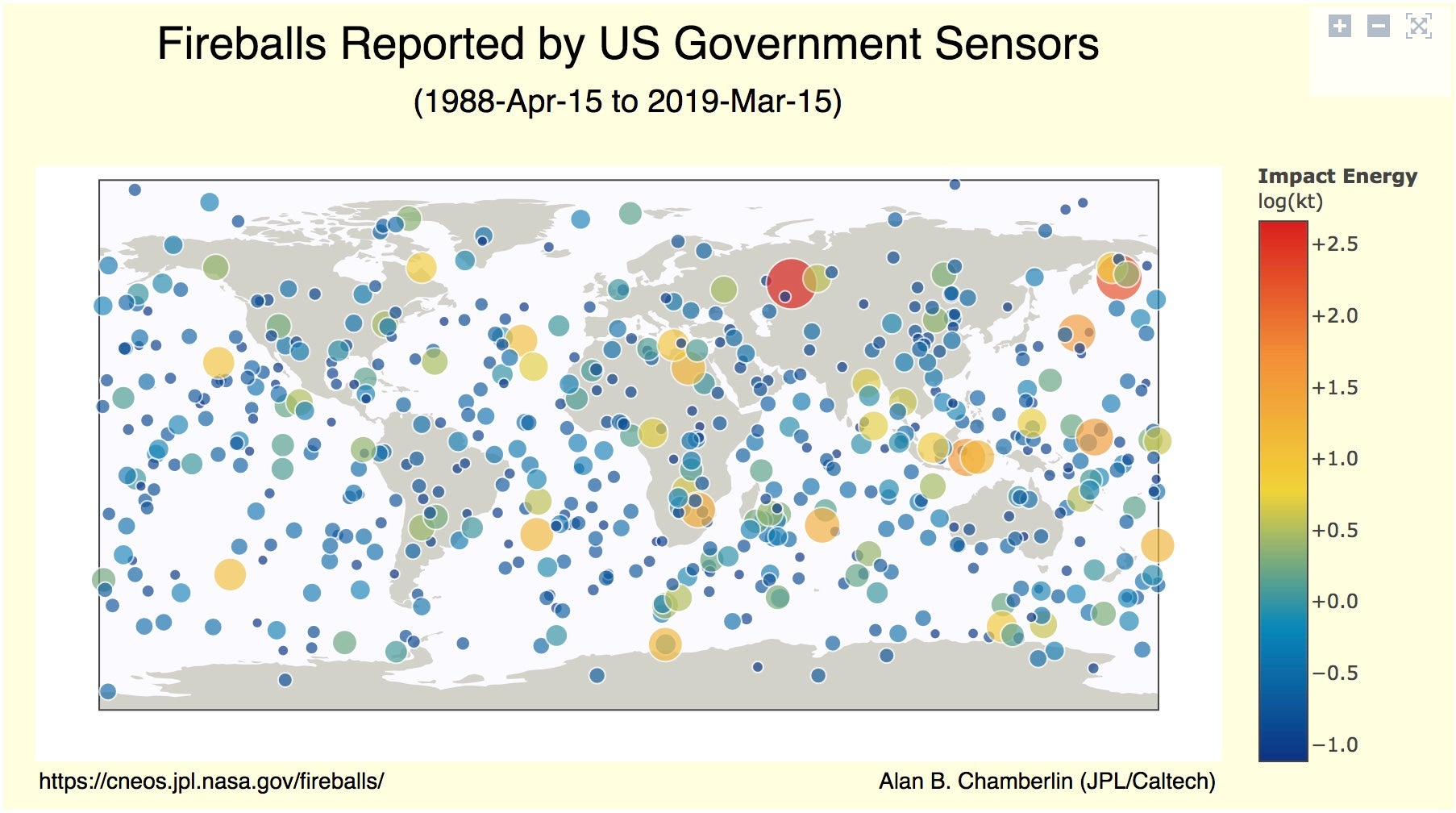
You can see from this data that since just 1988 there have actually been numerous '10 kiloton' class meteor events around the globe. But because 70% of the planet's surface is ocean, most of these have happened away from land.
It's worth pausing to consider that at this time we have only incomplete information on objects with the potential to hit Earth that are of the order of a hundred to few hundred meters in size. Any of those would have significantly more destructive potential that anything in the above map.
Although that's rather worrying, we might distract ourselves by remembering that this bombardment is a continuation of the very same processes that began some 4.5 billion years ago with the formation of our solar system. Planets are, it seems, never really completed.