
This article was published in Scientific American’s former blog network and reflects the views of the author, not necessarily those of Scientific American
If you're reading this sometime around March 2020 you probably need cheering up. As our species deals with a particularly treacherous virus with global reach many of us find ourselves holed up, away from our normal routines, and in a state of heightened anxiety. Others of us may be dealing with the virus head-on, either in ourselves, our families, or as healthcare workers on the front lines. None of this is easy. None of this is what anyone wants.
Solace is a tricky thing to find. But in case it offers a momentary respite here are some intriguing, beautiful, awe inspiring resources and images that can remind us of the grander scope of where we find ourselves in the universe.
The National Map
On supporting science journalism
If you're enjoying this article, consider supporting our award-winning journalism by subscribing. By purchasing a subscription you are helping to ensure the future of impactful stories about the discoveries and ideas shaping our world today.
It may be US-centric, but it's still awesome. The US Geological Survey maintains a delicious array of data, imagery, and interactive features that put planetary wonder on display. The National Map is an amazing tool for seeing a continent in new ways. For example, try adding the geological layer or something like the NLCD canopy cover layer (yes, canopy as in trees). You can also explore the State Geologic Map Compilation.

State Geologic Map Compilation. Credit: USGS
1.8 billion pixels of Mars
NASA recently released a panoramic view of Mars from the Curiosity rover made using 1,000 images. Check out the page together with some explanatory videos and the following interactive 360 degree version.
Credit: NASA and JPL-Caltech
Earth from Saturn
On July 19th 2013, the Cassini mission at Saturn took an image looking back towards the Sun. In one frame it captured the pale blue dot of Earth, some 1.44 billion kilometers away. In the foreground Saturn is seen from its night side, with sunlight scattering off its inner ring system.

Graceful Ending
A reminder that even when the next chapter of a star's existence is the final one, it can also represent a beginning. The planetary nebula NGC 5189 is around 2,000-3,000 light years from us. It's the cast off outermost layers of stellar material from an aging system that appears to have contained two stars. One is a massive, messy creature known as a Wolf-Rayet star. the other is a diminutive white dwarf - the remaining innards of a star that was probably similar to our own Sun in mass. The gas and dust of this so-called planetary nebula may one day end up helping forge new stars and planets in the Milky Way.

NGC 5189. Credit: NASA, ESA, and the Hubble Heritage Team (STScI/AURA)
Majesty
One of the most majestic looking galaxies is the Sombrero Galaxy or NGC 4594. At a distance of some 31 million light years it may only be 30% the size of the Milky Way, but it packs an architectural punch. Encircling the bulge of bright stars is a colossal ring of molecular gas and dust, together with younger stars.

All has happened before, all will happen again
It may not be the most visually arresting image right away, but that changes once you know what it is. This picture, taken by the Atacama Large Millimeter/submillimeter Array (ALMA), shows light being emitted from the material of a proto-planetary disk around a very young star (HL Tauri) 450 light years away. This is literally the birthplace of new worlds - some of which may be responsible for the dark rings, where matter has been swept up into, or rearranged by, proto-planetary objects. Surrounding all of this, unseen in the long wavelength light of the image, is a massive cloud of yet more dust and gas. This scene, or something like it, was us 4.5 billion years ago.

Credit: ALMA (ESO, NAOJ and NRAO)
Home Again
We've become used to seeing Earth from space, but it can still surprise and delight. Here's an image that doesn't get used so often, taken by ESA's Rosetta comet-chasing spacecraft back in 2013 when it completed its third and final swing-by to use Earth's gravity to adjust its course. From 630,000 km away we can see the bright features of pack ice off the Antarctic coastline in the lower part of the image. A planet that looks mysterious and alluring. Unarguably a safe harbor in the universe, irrespective of its daily challenges.
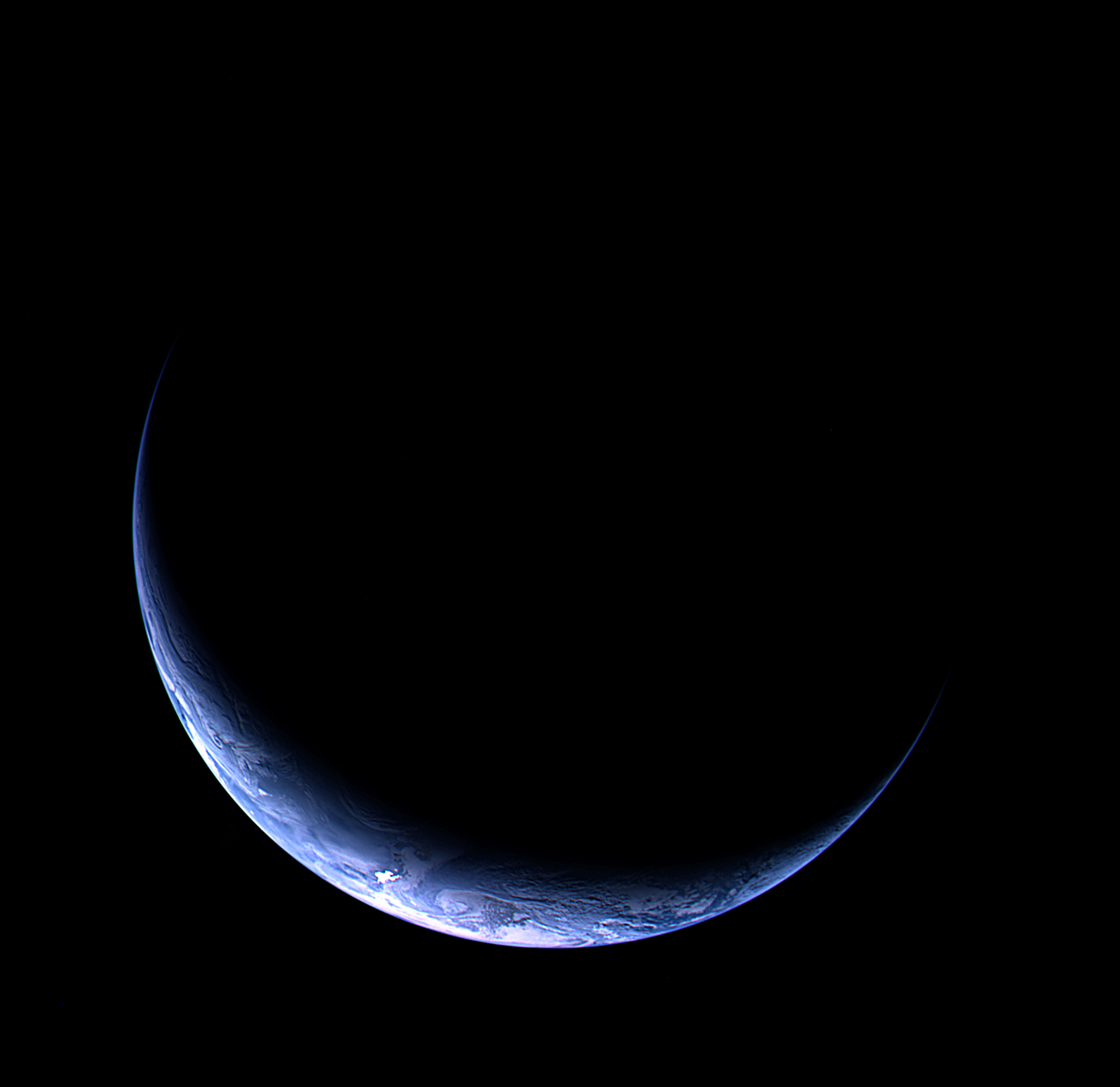
Earth from the Rosetta spacecraft. Credit: ESA