
This article was published in Scientific American’s former blog network and reflects the views of the author, not necessarily those of Scientific American
In astrobiology the idea of planetary 'habitability' is largely predicated on what fraction of a terrestrial planet's surface can sustain liquid water over the course of a year. That's an extremely crude measure; it assumes that liquid water equates to the possibility of life, and little else. Nonetheless it's not a bad yardstick for taking a first pass look at whether or not an environment might be able to support life as we know it.
Based on this measure the modern Earth is roughly 85% habitable. But in the past few years, at least in the northern polar regions, we've been seeing some extraordinary and unnerving changes. Right now the Arctic regions are way, way warmer (actually, positively hotter) than would be expected for this season. Furthermore, the makeup of the sea-ice in the Arctic has been shifting more and more towards thinner, younger material - losing older ice that persists throughout the year.
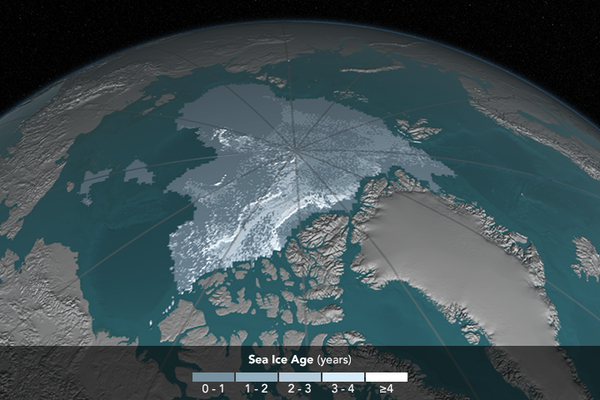
The numbers are actually staggering. Since the mid 1980s old, multi-year ice (more than 4 years in age) has gone from about 20% of the total ice cover to less than 3%. You can see this happen in data put together by NASA in this animation. It's like watching a swinging pendulum that is getting less and less able to return to where it started.
On supporting science journalism
If you're enjoying this article, consider supporting our award-winning journalism by subscribing. By purchasing a subscription you are helping to ensure the future of impactful stories about the discoveries and ideas shaping our world today.
This movie was assembled from a rich array of data, as described by the NASA Earth Observatory website:
"The visualizations are based on data from drifting buoys, weather stations, computer models, and 12 satellites (mostly passive microwave instruments) that have made measurements over the past four decades. Passive microwave instruments measure brightness temperature, the microwave energy emitted by sea ice due to its temperature, salinity, surface texture, and the amount of snow on top of it. Each ice floe has a characteristic brightness temperature, so researchers developed a way to identify and track ice floes in successive microwave images as they moved across the Arctic."
The animation spans the past 30 years, and the old sea-ice (lighter tones) just gets less and less.
Old ice is also thicker, so that means there is literally less ice overall in the Arctic - both in summer extent and in total volume.
The bottom line is that it's getting easier and easier for the Earth environment to make the Arctic ice-free in the near future. The cause is of course the enhanced greenhouse gas content of our atmosphere due to human activity (to deny this is to deny physics itself).
Thus, on the face of it, from the perspective of astrobiology, you might be tempted to say that if anything the Earth could be getting more habitable. There is, and will be, more surface area that could sustain liquid water (assuming that the Antarctic doesn't somehow compensate, or extreme winter shifts at lower latitudes don't impact that habitability calculation).
But therein lies one of the biggest challenges facing our species, as well as astrobiology. Nothing about habitability is really that simple.
An ice-free Arctic will have profound effects on planet-wide systems. From weather patterns to ocean salinity, to the root populations of marine organisms (from microbes to whales), and all the other species that are connected to this ecology.
We may be about to learn the hard way that habitability is a lot more than just how much liquid water a planet can harbor.