
This article was published in Scientific American’s former blog network and reflects the views of the author, not necessarily those of Scientific American
Are humans special?
The answer to this question naturally depends on the context. If you ask whether we're special in comparison to the rest of life on the Earth, then the answer is that we're both special and not-special, like pretty much every single species of living thing. On the other hand, if you ask whether we're special in a cosmic sense - as the sole known example of complex, thinking, technological life in the universe - the answer is 'perhaps'.
We can also pick apart our genetic heritage in some detail to look for clues. We can further match that molecular history to paleontological finds and archeological evidence of what our direct ancestors and hominid relatives were getting up to millions of years ago. In that mass of data are all kinds of things that point to specialness. There are genes for certain digestive enzymes, evidence of particular retrovirus resistance or susceptibility, and physiological traits that either lead or follow the capacity for language and society.
On supporting science journalism
If you're enjoying this article, consider supporting our award-winning journalism by subscribing. By purchasing a subscription you are helping to ensure the future of impactful stories about the discoveries and ideas shaping our world today.
Of course a similar story is typically true of any modern species. Pick a tree shrew or a wombat, a dogfish or a stick insect and you'll find a remarkable evolutionary tale. The trajectory through the past is full of 'Wow!' moments for any living thing.
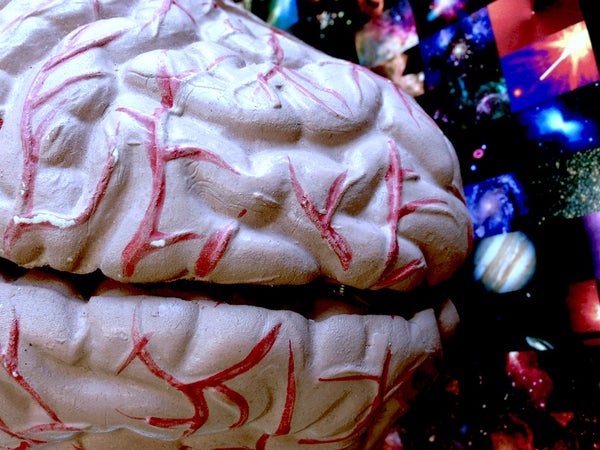
But humans. Well, humans do have these remarkable brains. While we're far from alone in terms of size and neuron count (elephants for example have approximately 300 billion neurons compared to our 100 billion), the twists and turns of natural selection have left us with certain capabilities that put us in a novel position.
We're the only species on Earth (apart perhaps from some hardly microbial forms) capable of getting off-world and surviving the experience. We're the only species capable of (and interested in) self-examination and world-examination - in a way that has led us to mathematics, physics, chemistry, biology, computation and technology. Minds have brought us food, health, and individual longevity.
Degrade those neural networks and we don't just become drastically less capable, we can quickly become incapable of even rudimentary survival. That is true for individuals, it is also true for our species.
So the spread of a still-poorly-understood pathogen like the Zika virus, one that seems to have a specially damaging effect on forming human brains, is particularly worrying. If, as seems to be the case, Zika can be transmitted not just via mosquito bites but also through human sexual contact, this virus is going to be tough to deal with.
Of course we've also become pretty adept at making vaccines, and inhibitory drugs, so with luck it will be possible to prevent Zika from causing too much more damage and heartache than it has already.
But Zika isn't the only virus or infection that attacks developing brains. Other unlovely agents, like a newly identified 'parechovirus', can cause problems, and many other known infections and medical situations can result in neurological issues.
From a global perspective though, something like Zika - emerging relatively quickly and with a seemingly diverse and efficient set of mechanisms for dispersal - is particularly chilling. It doesn't kill us immediately, it simply prevents our minds from developing fully in the first place. It damages that very thing that makes us a special species.
While in no way trying to trivialize the very real danger and pain of Zika today and in the coming months, I think that it is also worth considering this type of pathogen in the broader context of intelligent life in the universe. It's an intellectual exercise for sure, but leaving it unsaid doesn't seem any wiser than stating it.
What if the thing that destroys us as a species is not a vast physical calamity (asteroid, climate change, nuclear war) or a comparatively simple disease that kills us on the spot, but something truly insidious? A change wrought in our brains, an infection - or range of infections - that over time acts to stop us being an intelligent, technological life-form.
And what if this is a challenge that faces all intelligent life anywhere? Viruses are incredible opportunists, if there's a way to operate they'll find it. If complex growing neurons (or some cosmic equivalent) are a good incubator then at some point nature's endless molecular search engine will produce some kind of pathogen to take advantage of the situation.
We of course don't know that viruses are any more universal than our biology and our types of brain are. But it seems that if there are other biospheres out there on a par with the Earth it's a pretty good bet they will at least as complex at all levels.
If pathogens arise that explicitly target brains it might not always be the case that they're fast acting or very obvious. One could imagine that by the time a species recognizes what's going on it's no longer smart enough (at least collectively) to solve the problem. Or (perhaps worse) a species fails to notice at all, and its civilization dims into the eternal night of neural simplicity, never quite understanding why.
So it's possible that here is another addition to the long list of reasons for the seeming absence of other civilizations in the universe: intelligence will always be beaten by pathogens capable of degrading minds.
I am sure that some of these ideas run roughshod over all manner of insights to the nature of viruses, other pathogens, brain development, and evolutionary biology. But ideas are just that, they're there to be dismissed or debated, while we still can.