
This article was published in Scientific American’s former blog network and reflects the views of the author, not necessarily those of Scientific American
We live in an age where we have maps of other worlds that almost rival what you use to navigate your way from coffee shop to couch. For a planet like Mars we have robotic explorers sending back daily data (when not interrupted by global dust storms). It is very easy to forget that half a century ago we had none of this.
Before NASA’s Mariner 4 spacecraft made the first successful flyby of Mars in July 1965 we had very rudimentary knowledge about this world.
Take for example a classic paper by Carl Sagan and Paul Swan, published in early 1965 (ahead of the Mariner 4 flyby). This study was titled: “Martian Landing Sites for the Voyager Mission” (note that this was not the same Voyager as later toured the solar system). Here Sagan and Swan discuss a mission strategy already under development that could have used Saturn V’s for launch, and a combination of orbiters and landers that presaged what was eventually done in the Viking missions.
On supporting science journalism
If you're enjoying this article, consider supporting our award-winning journalism by subscribing. By purchasing a subscription you are helping to ensure the future of impactful stories about the discoveries and ideas shaping our world today.
But perhaps the most revealing part of this document is this statement on the first page:
“The present body of scientific evidence suggests, but does not unambiguously demonstrate, the existence of life on Mars. In particular, the photometrically observed waves of darkening which proceed from the vaporizing polar caps through the dark areas of the Martian surface have been interpreted in terms of seasonal biological activity”
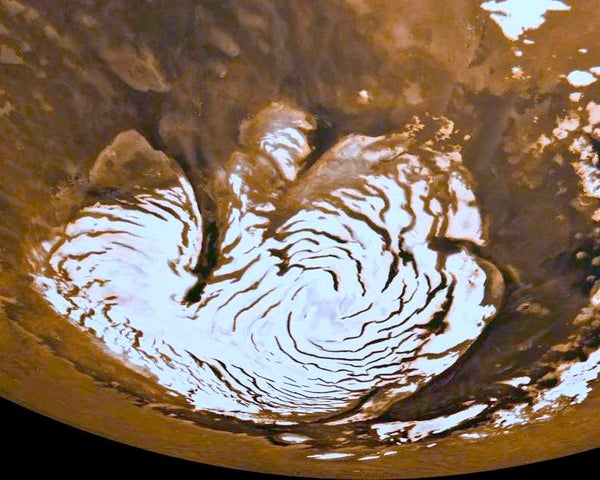
The “waves of darkening” were a phenomenon that had been observed on the red planet since the 19th century.
Over the course of a Martian year astronomers would see that the dark areas adjacent to the poles in a particular hemisphere of Mars would seem to get even darker in the local spring and summer. Of course, the resolution of the images was extremely crude by modern standards, so the darkening was more of a statistical observation than a well-mapped phenomenon.
A study by Pollack, Greenburg and Sagan, published in 1967 (after the Mariner 4 flyby in 1965, but before the definitive Mariner 9 orbiter in 1971) posited two plausible explanations: the seasonal transport of dust onto and off these regions, or the response of vegetation to changes in atmospheric water vapor (due to ice cap melting or evaporation).
We now know that the “waves of darkening” are indeed due to non-biological surface changes. Dust moves around on Mars, and there are strong seasonal changes in atmospheric pressure as the carbon dioxide ice caps sublimate and freeze. But as recently as the late 1960s we were still open to the possibility of large swathes of surface vegetation growing on Mars.
It is a sobering lesson. In astrobiology and exoplanetary science one of our key goals (if not the Holy Grail) is to determine whether or not life has happened elsewhere in the universe. Currently we think that one option for success is to detect the atmospheric chemical markers of life on a distant world. We also know that this is going to be complicated – even a classic ‘biomarker’ like oxygen need not indicate the presence of life.
Another possibility, perhaps further down the line, is to sense the spectral changes of light reflected from a planet due to photosynthetic pigments and cell structures. Yet another marker may be to track how a planet’s environment responds to seasonal variation, through changing atmospheric compositions (like carbon dioxide on Earth), clouds and other phenomena.
The history of our remote study of Mars should provide some insight to the challenge of getting this science right. Planets are dynamic places, with or without life. And since life itself piggybacks onto planetary environment – from climate to chemistry – it stands to reason that many of the outward characteristics of a planet are going to reek of ambiguity.
This is one reason why solar system exploration is absolutely critical for the big questions we have about cosmic life and our own significance. This is the only place where we can obtain ground-truth data to help correct our imaginative biases.