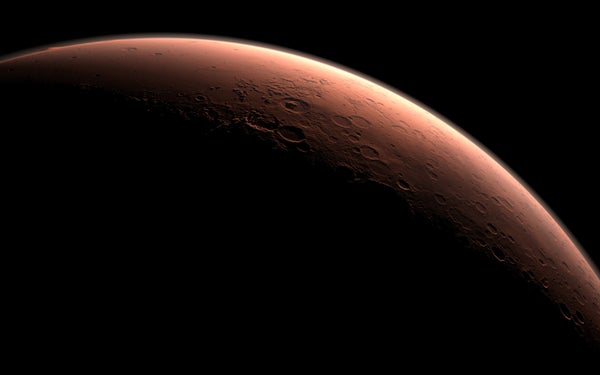
NASA's 50 Years of Mars Exploration [Video]

Humans have been visiting and exploring Mars for more than half a century, and NASA has released a video celebrating the agency's remarkable contributions

Join Our Community of Science Lovers!

This article was published in Scientific American’s former blog network and reflects the views of the author, not necessarily those of Scientific American


It seems hard to believe, but since the 1960's humans have been sending spacecraft to Mars. The earliest pioneers were the robotic vehicles of the Soviet Union in 1960 and 1962 - but these faced a host of teething problems, from launch failures to communication failures en route to the red planet.

In 1964 NASA's Mariner 4 became humanity's first successful mission to Mars, returning images that immediately laid to rest most of our speculations about this world being any kind of Earth-analog. Mars was dry, dusty, well-cratered, and very alien.

Recently NASA posted the following video montage of all (successful) Mars missions the agency has undertaken, as well as a glimpse to the future. It's naturally rather self-congratulatory, but hey, if you can explore another world with this degree of skill I think you're allowed a little bit of celebration. And in this era of political uncertainty it doesn't hurt to remind us all of what you can do for a tiny fraction of the US GDP.


On supporting science journalism

If you're enjoying this article, consider supporting our award-winning journalism by subscribing. By purchasing a subscription you are helping to ensure the future of impactful stories about the discoveries and ideas shaping our world today.


The universe is out there, let's go look. 

(Credit: NASA, JPL, Caltech)

It’s Time to Stand Up for Science

If you enjoyed this article, I’d like to ask for your support. Scientific American has served as an advocate for science and industry for 180 years, and right now may be the most critical moment in that two-century history.

I’ve been a Scientific American subscriber since I was 12 years old, and it helped shape the way I look at the world. SciAm always educates and delights me, and inspires a sense of awe for our vast, beautiful universe. I hope it does that for you, too.

If you subscribe to Scientific American, you help ensure that our coverage is centered on meaningful research and discovery; that we have the resources to report on the decisions that threaten labs across the U.S.; and that we support both budding and working scientists at a time when the value of science itself too often goes unrecognized.

In return, you get essential news, captivating podcasts, brilliant infographics, can't-miss newsletters, must-watch videos, challenging games, and the science world's best writing and reporting. You can even gift someone a subscription.

There has never been a more important time for us to stand up and show why science matters. I hope you’ll support us in that mission.

Thank you,

David M. Ewalt, Editor in Chief, Scientific American

Subscribe