

This article was published in Scientific American’s former blog network and reflects the views of the author, not necessarily those of Scientific American
Every time that a rocket launch goes awry one can only feel for the hundreds, if not thousands, of people who have poured their technical prowess into making these attempts. From the engineers and machinists, to the investors and spacecraft technicians, and often the scientists and researchers. It can be heartbreaking to watch years, or even decades of work go up in smoke.
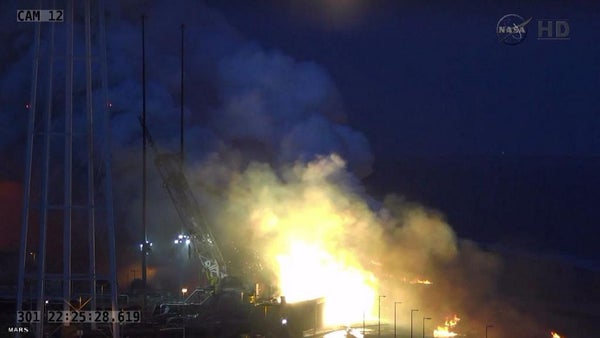
In that sense the recent SpaceX rocket failure was simply another reminder that pushing things into space on top of a controlled explosion is unlikely to ever be completely routine. It's another reason why astronauts, cosmonauts, and taikonauts are genuinely brave people.
But to put all of this in a little more context it's interesting to look at overall space launch statistics. A rather nice resource for this is the site 'Space Launch Report'. Here I've reproduced the launch counts for 2015 from the information on those pages.
On supporting science journalism
If you're enjoying this article, consider supporting our award-winning journalism by subscribing. By purchasing a subscription you are helping to ensure the future of impactful stories about the discoveries and ideas shaping our world today.
-------------------------------------------------------------------
Vehicle Overall By Orbit Type
Launches Earth-Orbit Earth-Escape
(Failures) LEO >LEO Deep Space
-------------------------------------------------------------------
CZ (DF-5) 17(0) 8(0) 9(0) -
R-7 16(1) 12(1) 4(0) -
Atlas 5 9(0) 3(0) 6(0) -
Proton 8(1) - 8(1) -
Falcon 9 7(1) 4(1) 3(0) -
Ariane 5 6(0) - 6(0) -
PSLV 4(0) 3(0) 1(0) -
H-2A 3(0) 2(0) 1(0) -
Delta 4 2(0) - 2(0) -
Rokot/Briz KM 2(0) 2(0) - -
Vega 2(0) 2(0) - -
Zenit 1(0) - 1(0) -
GSLV 1(0) - 1(0) -
H-2B 1(0) 1(0) - -
Delta 2 1(0) 1(0) - -
Dnepr 1(0) 1(0) - -
CZ-6 1(0) 1(0) - -
CZ-11 1(0) 1(0) - -
Safir 1B 1(0) 1(0) - -
Soyuz 2-1v 1(1) 1(1) - -
Super Strypi 1(1) 1(1) - -
---------------------------------------------------------
Total 86(5) 44(4) 42(1) -
So the impressive thing is that the global launch industry had 5 failures out of 86 launches in 2015 (a 5.8% failure rate in raw numbers). In fact, looking deeper at the statistics (compiled by Ed Kyle) it's truly remarkable how well rocket launches typically go - considering the hazards that they have to engineer into 'acceptable' limits.
A launcher like a Delta 2 has a predicted orbital success rate of 98% (based on prior performance), as does the Soyuz-FG. A SpaceX Falcon 9 v1.2 comes in at about 90%. Although those are among the highest predicted success rates, of the 49 or so launch vehicles in active use today, only 16 actually fall below the 75% level for this measure - and these are running into small-number statistics.
Getting into space is tough, the amazing thing is how good we've got at doing it.