
This article was published in Scientific American’s former blog network and reflects the views of the author, not necessarily those of Scientific American
Unless you've been living under a rock in recent months you'll know that on September 15th, 2017 the Cassini spacecraft—all 2,150 kilos of it—will end its remarkable mission with a destructive plunge into Saturn's atmosphere.
In a very real sense the robotic probe will at last become a part of the very system it has so diligently studied since 2004.
In the lead-up to that moment Cassini has been swooping across Saturn on Grand Finale orbits that take the craft within the ring structures themselves. This vantage point (and those still outside the rings) is producing some truly stunning images—perhaps not so much because they show Saturn in a radically different way (although some do), but because they offer a novel perspective, the kind of perspective that artists and astrophysical dreamers have only imagined until now.
On supporting science journalism
If you're enjoying this article, consider supporting our award-winning journalism by subscribing. By purchasing a subscription you are helping to ensure the future of impactful stories about the discoveries and ideas shaping our world today.
Here are some of those portraits:

View across Saturn's hazy upper atmosphere, with the rings looming above the sunlit horizon. Credit: NASA, JPL-Caltech, Space Science Institute

A false-color view of near-infrared features in Saturn's atmosphere - showing bands and turbulence in cloud structures in the planet's northern hemisphere. Credit: NASA, JPL-Caltech, Space Science Institute

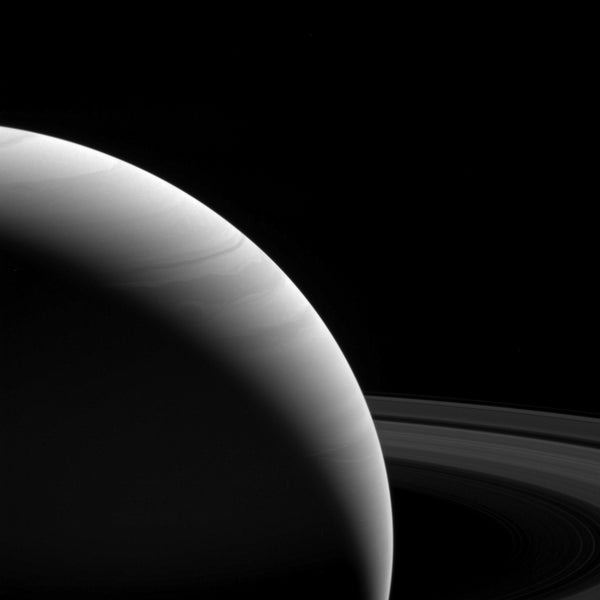
Sunlit Saturn, with its rings still in night. Credit: NASA, JPL-Caltech, Space Science Institute

Saturn's north pole seen in the near infra-red. Credit: NASA, JPL-Caltech, Space Science Institute

In the northern saturnian summer the planet's shadow onto the rings grows shorter. This view is from 760,000 miles. Credit: NASA, JPL-Caltech, Space Science Institute