
This article was published in Scientific American’s former blog network and reflects the views of the author, not necessarily those of Scientific American
Ask an astronomically-inclined astrobiologist what their favorite research paper of the past three decades is and there's a good chance they'll say 'the Galileo flyby of Earth'.
In 1990, NASA's Galileo mission to Jupiter took a swing by the Earth as part of its orbital maneuvering to gain enough velocity and the right trajectory to head on out to Jupiter. During that close pass - about 960 kilometers above the Caribbean - Galileo had its scientific instruments fired up. That data helped shake down the mission's systems, but also afforded a unique opportunity to study the Earth as if it were an alien world.
Written by Carl Sagan and colleagues: "A search for life on Earth from the Galileo spacecraft", published in 1993, was a beautiful thought-experiment made real, a control for future efforts to find life far beyond. The conclusion, combining observations of atmospheric composition (ohh, look, methane!), reflectivity, and even radio waves, was that this blue-green world might very well harbor living things.
On supporting science journalism
If you're enjoying this article, consider supporting our award-winning journalism by subscribing. By purchasing a subscription you are helping to ensure the future of impactful stories about the discoveries and ideas shaping our world today.
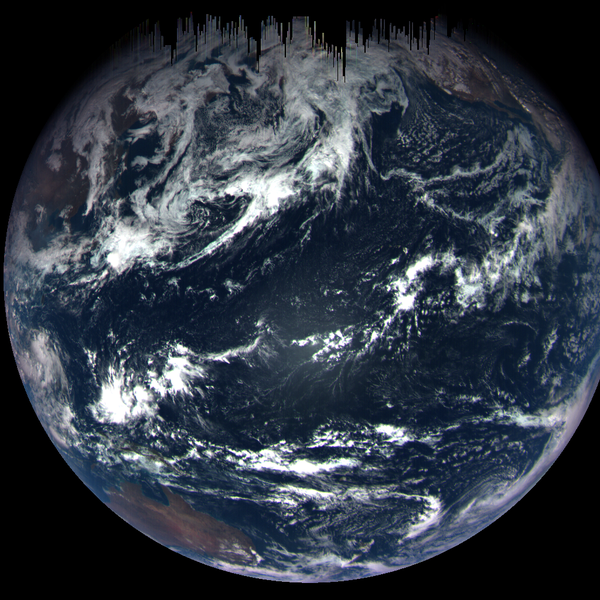
Flash forward to 2017, and on September 22nd NASA's OSIRIS-REx asteroid-sampling mission performed a similar flyby. Swooping across the southern polar end of Earth at an altitude of about 11,000 km, the spacecraft used the planetary gravitational field to tweak the inclination of its trajectory, aiming up out of the ecliptic plane for a rendezvous in August 2018 with the asteroid Bennu.
But OSIRIS-REx kept busy, and as it zipped past Earth it had one of its imaging cameras and a visible-and-infrared spectrometer and thermal (far IR) spectrometer switched on to grab a set of wonderful datasets (below) that echo the way that the Galileo mission studied the Earth.

Earth in flyby. Credit: NASA, Goddard and University of Arizona
And two beautiful spectra showing key components of Earth's atmosphere.
.png?w=1350)

Looking at these data, and especially the spectra of reflected and emitted light from the Earth, we can immediately see some tantalizing evidence for a world infected with biology. There are clear signs of both oxygen and methane in the atmosphere, there is plenty of water vapor, ozone, and an ocean temperature of a passable 13 Celsius emission temperature.
It's another beautiful, even if serendipitous experiment.