
This article was published in Scientific American’s former blog network and reflects the views of the author, not necessarily those of Scientific American
Many stars are formed in multiples – bound in orbits around each other, or even in hierarchical groupings where single stars can orbit stellar pairs (binaries), or pairs can orbit other multiples.
For a long time astronomers thought that the majority of stars were actually in these sibling configurations. But in recent years that received wisdom has come under greater scrutiny, and it may be that only a minor fraction (less than a third) of stars in the Milky Way actually have gravitationally bound companions.
In either case, there are two primary candidate mechanisms for building stellar multiples. One is the turbulent ‘fragmentation’ of a dense molecular cloud (nebula) into collectives of stars, and the other is that the proto-stellar disk of a gravitationally condensing system can itself experience fragmentation through dynamical instabilities – literally ‘budding’ into more than one dense stellar core.
On supporting science journalism
If you're enjoying this article, consider supporting our award-winning journalism by subscribing. By purchasing a subscription you are helping to ensure the future of impactful stories about the discoveries and ideas shaping our world today.
The former mechanism could make widely spread stellar pairings (thousands of times more separated than the Earth-Sun distance – an astronomical unit, AU), while the latter could make closely bound sets.
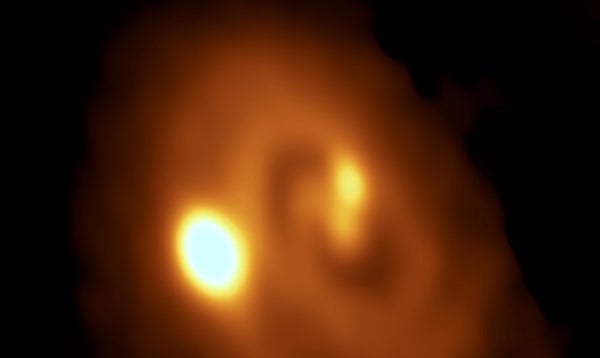
Direct evidence of the formation of tightly orbiting stars out of a single proto-stellar disk has been somewhat lacking. But now the Atacama Large Millimeter/submillimeter Array telescope (ALMA) – an international observatory high in Chile’s Atacama Desert – has managed to take a remarkable image of a very young stellar system some 750 light years away that appears to show the disk instability process of star formation caught in the act.

ALMA image of the L1448 IRS3B system. Credit: Bill Saxton, ALMA (ESO, NAOJ, NRAO), NRAO, AUI, NSF
The ALMA picture shows the glow of warm dust in this very young system, and a pair of tightly orbiting baby stars (to the right) with a third forming star apparently emerging out of a spiral-like disturbance in the proto-stellar disk (to the left).
Reporting their work in Nature in October 2016, Tobin et al. propose that this is direct evidence for disk-fragmentation that forms proto-stellar objects.
The scale is still large by our solar system standards. The inner pair of young stars are separated by about 61 AU, while the third stellar infant is about 183 AU further out.
If the present interpretation of this data is correct, we’ve now seen the mechanism for making close stellar multiples in action – and with enough fidelity that computer simulations can now be made to try to match the precise physics at play. It's a tremendously exciting step towards decoding the formation and evolution of all stars.