
This article was published in Scientific American’s former blog network and reflects the views of the author, not necessarily those of Scientific American
As the northern parts of North America experience some extreme low temperatures it's interesting to consider just how cold our planet can be in places. Of course it's also important to recognize that these temporary, localized deep freezes in the US and Canada also come against a backdrop of indisputable global warming. Indeed, the mechanism for chilling lower latitudes than normal is the relative weakening of atmospheric flows that otherwise help separate polar cold air from the rest of the planet. That weakening is directly attributable to changes brought about by global warming and anthropogenic greenhouse gases.
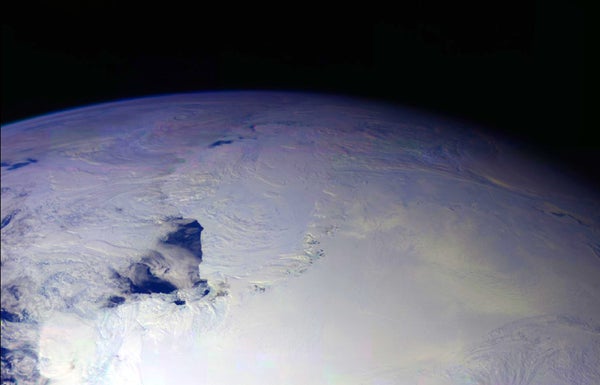
But there endeth the sermon. The actual record holder for the coldest natural environment on Earth is a toss-up between two locations in Antarctica.
The best-known place (if anywhere in Antarctica can claim to be) is Vostok Station. Sitting deep inside the continent at an altitude of 3,488 meters this research site has the lowest temperature ever measure in-situ at ground level, hitting an astonishing -89.2 Celsius (-128.6 F or 184 Kelvin) in 1983.
On supporting science journalism
If you're enjoying this article, consider supporting our award-winning journalism by subscribing. By purchasing a subscription you are helping to ensure the future of impactful stories about the discoveries and ideas shaping our world today.
But there is another contender for this record. Dome Fuji (or Dome F) is almost 70 degrees in longitude away from Vostok but at the same latitude of close to 78 degrees south, and sits around 3,810 meters altitude. In 2010 satellite data on surface temperatures of a ridge line area close to Dome Fuji indicated a low of -93.2 Celsius (-135.8 F).
This extraordinary cold was a measurement of the ice surface temperature, whereas the Vostok data reflected the local air temperature. In that sense it's not really fair to compare these two points, but it's probably fair to say that somewhere among the high points of Antarctica are Earth's coldest natural places.
Of course they're not the absolutely coldest places on Earth. Those, rather ironically, exist precisely because the planet is mostly much warmer and habitable by a variety of surface life.
Indeed, if you live anywhere near a major urban center you are probably close to a place that sits at around -263 Celsius (ten degrees above absolute zero) - in the liquid helium of your local MRI facility. And elsewhere on the planet, in a variety of laboratories you might find even lower temperatures. The current record (as far as I know) is for chilling a piece of rhodium metal to 0.0000000001 degrees above absolute zero - which is substantially colder than the mean temperature of the universe's background radiation field, at about 2.725 Kelvin.
So take heart if you're experiencing a polar cold, it will get warmer again, and it could be much worse.