
This article was published in Scientific American’s former blog network and reflects the views of the author, not necessarily those of Scientific American
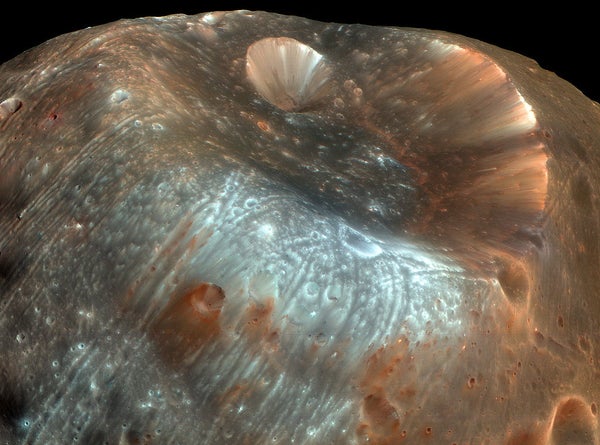
Phobos is a groovy moon. This diminutive natural satellite of Mars, about 20 kilometers across and potato-shaped, has a striking pattern of parallel linear markings or grooves running over its surface. These are clearly visible in this lower image taken by the Mars Reconnaisance Orbiter in 2008 and although they may appear related to the great Stickney impact crater to the right, they are likely not.

Phobos (Credit: NASA/JPL-Caltech/University of Arizona)
So how did Phobos get its grooves?
On supporting science journalism
If you're enjoying this article, consider supporting our award-winning journalism by subscribing. By purchasing a subscription you are helping to ensure the future of impactful stories about the discoveries and ideas shaping our world today.
A new study suggests that the answer exists in the moon's orbit and its composition. Phobos zips around Mars at a remarkably low altitutde of roughly 6,000 kilometers, circumnavigating the planet every 7 hours and forty minutes.
That orbit, with a period shorter than the rotation period of Mars itself, puts Phobos in a very slow, but inexorable death spiral - dropping closer to Mars by about 2 meters every century. The culprit being gravitational tidal deceleration.
Eventually, in perhaps 30 to 50 million years, tidal forces will pull Phobos apart. But it seems that the grooves on the moon's surface could be a direct precursor to that eventual disruption.

Phobos (Credit: NASA/JPL/Viking 1)
The precise cause of these strange surface features has been debated for some time. When the grooves were spotted during the Viking missions to Mars in the late 1970s they were posited to be a result of gravitational tides. But if Phobos was mostly a solid, dense, body that explanation seemed unlikely.
However, the structure of Phobos is now thought to possibly be more akin to a 'rubble-pile' (something seen in asteroidal bodies) coated in a 'skin' of dusty, but somewhat cohesive material about 100 meters in thickness. The tidal stretching and squeezing as the moon orbits Mars could cause this skin to fracture, or give way, causing the grooves. The direction of the markings seems to fit well with the expectations of models of how those tidal forces would manifest themselves.
In other words, Phobos may be bearing the scars of what will eventually kill it. Failure is not an option, it is an inveitability.
