
This article was published in Scientific American’s former blog network and reflects the views of the author, not necessarily those of Scientific American
On July 14th 2015 NASA's New Horizons spacecraft finally reaches Pluto. But the encounter is brief.
During the span of just a few hours, the mission will punch through the principle plane of the Plutonian system - containing the orbits of its currently identified set of five companion moons. The science instruments will be busy gathering as much information as possible, as they will be doing prior to, and after, this closest approach.
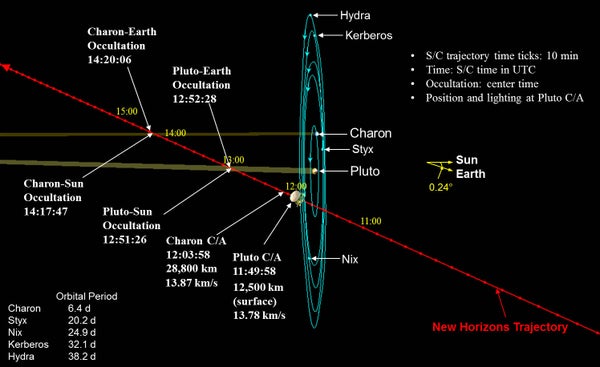
The anticipated timeline is nicely illustrated in this diagram from the Johns Hopkins University Applied Physics Laboratory and the Southwest Research Institute. The trajectory runs from right to left.
On supporting science journalism
If you're enjoying this article, consider supporting our award-winning journalism by subscribing. By purchasing a subscription you are helping to ensure the future of impactful stories about the discoveries and ideas shaping our world today.

The expected timeline and trajectory for the Pluto encounter on July 14th, 2015 (Credit: NASA/Johns Hopkins University Applied Physics Laboratory/Southwest Research Institute)
Thus far there are no show-stoppers – there appear to be no additional moons or significant dust rings in the region that New Horizons will pass through. Moving at close to 50,000 km/hour, even a tiny speck of material could be hazardous to the spacecraft.
It won’t just be New Horizons that’s busy during the encounter. As the mission passes behind Pluto from our viewpoint, a carefully timed radio signal from the Earth will wash across the system (accounting for the roughly 4.5 hour light travel time between us and Pluto). The spacecraft will monitor for the disappearance (occultation) and reappearance of this signal – helping pin down Pluto’s true diameter and the properties of its exceedingly tenuous atmosphere.
This is a different approach than many occultation experiments - where it's the signal from the spacecraft that is monitored. In this case the sheer distance of Pluto means that better luck is expected by utilizing more powerful (by 3-4 orders of magnitude) radio transmissions from the Deep Space Network here on Earth and the special REX instrument onboard New Horizons.
At these distances, with limited bandwidth, it will take some days to get the first compressed datasets, and potentially months before the full encounter imagery and measurements trickle back to us.
Just how good will the imagery be? That’s hard to know for sure. But this artist’s impression of the degree of improvement of New Horizon’s mapping of Pluto and Charon compared to our enhanced, interpreted, data from the Hubble Space Telescope may give a litle foretaste of what to expect.
