
This article was published in Scientific American’s former blog network and reflects the views of the author, not necessarily those of Scientific American
A week or so ago a private space launch company, Rocket Lab, launched its Electron rocket from New Zealand to put a number of small satellites into orbit. In most respects this was a great example of the burgeoning space industry and the innovative developments happening in nano-satellite technology, with a payload that included an Earth imaging satellite, and others aimed at weather monitoring and ship tracking. Hurrah!
But there was an additional payload that Rocket Lab had put onboard in secret: a highly reflective, roughly meter-sized geodesic sphere. Called the 'Humanity Star' its purpose is, and I quote directly from the Rocket Lab 'Humanity Star' web page:
"Visible from earth with the naked eye, the Humanity Star is a highly reflective satellite that blinks brightly across the night sky to create a shared experience for everyone on the planet.
On supporting science journalism
If you're enjoying this article, consider supporting our award-winning journalism by subscribing. By purchasing a subscription you are helping to ensure the future of impactful stories about the discoveries and ideas shaping our world today.
Created by Rocket Lab founder and CEO Peter Beck, the Humanity Star is a geodesic sphere made from carbon fibre with 65 highly reflective panels. It spins rapidly, reflecting the sun’s rays back to Earth, creating a flashing light that can be seen against a backdrop of stars.
Orbiting the Earth every 90 minutes and visible from anywhere on the globe, the Humanity Star is designed to be a bright symbol and reminder to all on Earth about our fragile place in the universe."
This object will stay up for about 9 months before atmospheric drag causes its orbit to decay.
On the face of it, this all sounds like jolly nice fun. A sparkly thingy whizzing across our skies, blinking and reminding us all of our cosmic heritage. To a large degree I like that idea, but it also fills me with a big dose of dread.
Here's the thing. We live in a world where the natural rhythms are being eroded. Day and night are actually less and less distinct for many of us. A recent study charted the growth of artificial light in our cities and habitats, and the results are pretty staggering. Human eyes are getting less and less opportunity to adapt to the natural, exterior night. Earlier studies have also suggested that plants and animals are struggling to adapt to the human-lit zones of the planet. Even insect pollination is being impacted.
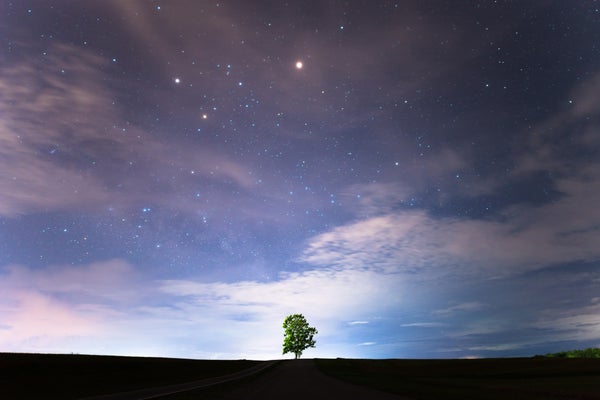
And we are increasingly denying ourselves the ability to see the true night sky, the stars, the cosmos. This is not just a problem for the casual observer, it's a major issue for modern astronomy, with fewer and fewer places on the planet where we can set up telescopes that aren't made less sensitive because of artificial light pollution.
Satellites impact this science as well. With about 2,000 known artificial satellites orbiting Earth (not counting true space junk) astronomers are well used to finding their hard won images streaked with the destructive light trails of glinting objects as they pass overhead. This problem may become more acute in the future as large telescopes like the LSST seek to repeatedly scan the sky night after night, looking in part for cosmic events unfolding - from supernovae to the entirely unexpected. Human-made blights on these precious data will be a pain to deal with, like having vermin invade your pantry.
Is an object like the Humanity Star a major problem? Well, to be fair it's not going to single-handedly demolish astronomy or obscure our view of the heavens. But I think it represents a curiously uninformed outlook on what our species is dealing with at the moment. It might have been cute to do this in the late 1950s, when Sputnik was fresh on our minds, when there was a genuine sense of wonder (and concern) about the future space age. But in 2018 it feels to me like yet another invasion of my personal universe, another flashing item asking for eyeballs. It's hogging some of that precious resource, the dark night sky, polluting part of the last great wilderness.
Most of us would not think it cute if I stuck a big flashing strobe-light on a polar bear, or emblazoned my company slogan across the perilous upper reaches of Everest. Jamming a brilliantly glinting sphere into the heavens feels similarly abusive. It's definitely a reminder of our fragile place in the universe, because it's infesting the very thing that we urgently need to cherish.
I hope that Rocket Lab continues to do its great launch services, but I also hope they make their publicity shine a little less brightly in the future.