
This article was published in Scientific American’s former blog network and reflects the views of the author, not necessarily those of Scientific American
The Voyager 2 spacecraft was launched August 20th 1977, and to confuse things Voyager 1 was launched two weeks later on September 5th 1977 - but still managed to get to Jupiter and Saturn ahead of its sister ship.
These two remarkable vehicles, and their epic journey, are therefore hitting the 40-year mark as I write this. In the history of solar system exploration I'm not sure any missions have yielded so much for so long - and embedded themselves in the human consciousness so powerfully.
But rather than wax too lyrical about their deep meaning, I thought it would be fun to take a brief look at what made (and makes) these pieces of 1970s and 1960s technology work.
On supporting science journalism
If you're enjoying this article, consider supporting our award-winning journalism by subscribing. By purchasing a subscription you are helping to ensure the future of impactful stories about the discoveries and ideas shaping our world today.
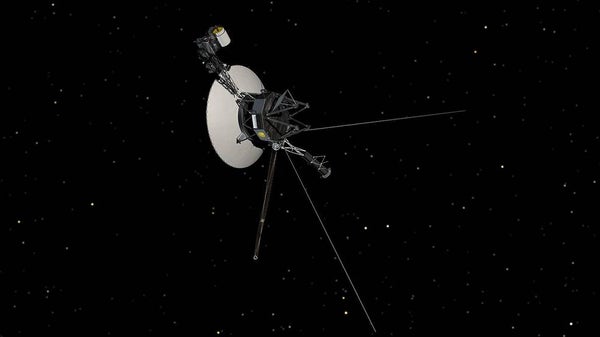
Both craft are about 830 kilograms in mass, with the now-iconic high-gain radio dish antenna spanning a sizable 3.7 meters (12 feet) in diameter. Each was built with 16 hydrazine thrusters, three gyroscopes to stabilize the x, y, z axes, 8 backup thrusters, three radioisotope thermoelectric generators (made with delicious plutonium-238 oxide), 11 science instruments (with redundant systems to help with failures), and three dual-redundant computer systems. All in all there are about 65,000 discrete parts making up each spacecraft.

Voyager Science Instruments. Credit: NASA, JPL
Those computer systems are impressive both for their primitive nature in today's electronic world, and for their capabilities. For example, each Voyager's computer hardware totals 69.63 kilobytes of memory. Barely enough for a crummy cell-phone image these days, heavily compressed. Although the Voyagers did actually employ volatile CMOS memory to match the cracking speed of their CMOS processors in the Flight Data System - capable of about 81,000 operations a second.
That sounds okay, until you realize that a recent iPhone has a processor capable of roughly 200 billion floating point operations a second.
For slightly longer term data storage the information was written onto 8-track digital tape - moving parts and all - before trickling back to the Earth at around 160 bits per second. The capacity of the tape? About half a megabyte.

Voyager Flight Data System hardware. Credit: NASA, JPL
But these were marvelous pieces of electronic hardware - heavily customized, finely tuned and designed. Just what you needed to go through interplanetary space for decades.
The science instruments are labeled in the schematic above. They range from imaging systems that are built out of slow-scan tv cameras (not the fully digital detectors we're all used to now, but equipped with 8 color filters on a wheel), to a host of detectors for sensing magnetic fields, plasmas, cosmic rays, and planetary radio waves.
By now though, with power dwindling in the Voyager probes' radioisotope generators, most science instruments have been switched off. Those operating include the plasma wave detectors, magnetometers and cosmic ray instruments.
How long can the Voyagers go on? Well, the spacecraft themselves will continue into interstellar space unabated, but current estimates are that around 2025 the power may drop to a point where both probes fall silent permanently.