
This article was published in Scientific American’s former blog network and reflects the views of the author, not necessarily those of Scientific American
On December 19th of 2015 Cassini made its final (but not closest) flyby of Saturn's moon Enceladus - an icy world almost certainly harboring a global subsurface ocean of liquid water. From some 3,100 miles away the mission was able to capture some exceedingly detailed images of surface areas last seen 10 years ago in earlier encounters.
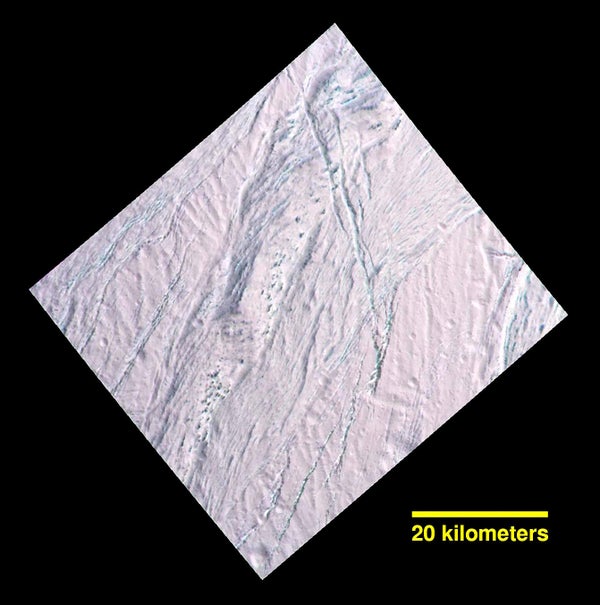
A particularly choice snapshot is this image (below) of the so-called Dalmatian Terrain - a zone with some curious mottled features on Enceladus's Saturn facing side, and close to the moon's equator.

Credit: NASA/JPL-Caltech/Space Science Institute
On supporting science journalism
If you're enjoying this article, consider supporting our award-winning journalism by subscribing. By purchasing a subscription you are helping to ensure the future of impactful stories about the discoveries and ideas shaping our world today.
These dark spots are revealed to be protrusions of solid 'bedrock' (ice) as well as ice blocks along a ridge line running north-south in this image orientation. The resolution of the image is about 200 feet (67 meters) per pixel, so the blocks and protruding bedrock are as small as just a few dozen feet across.
In NASA's released information the feature is described as if by a hiker down on Enceladus:
"To an observer on the surface, the prominent north-south trending ridge might look superficially like icy flatirons (tilted, triangular outcroppings of rock), but probably more shallowly dipping than terrestrial examples. The exposed line of ice blocks along its ridge crest might make it look a bit like a hogback (a narrow ridge with steep sides, often with vertical rocky outcrops along the top)."
We can compare and contrast this with an image from a different area on Enceladus, with even better resolution, taken during the October 28, 2015 closest pass at a mere 77 miles above the surface, and about 49 feet (15 meters) per pixel.

Credit: NASA/JPL-Caltech/Space Science Institute
This terrain is some 57 degrees south of the moon's equator, and seems rather more 'rough'. In fact it looks an awful lot like the weathered top of Earth's great glaciers. So it may be that taking a walk on this part of Enceladus would feel very much akin to hiking a place like Wolverine Glacier in Alaska (for example), shown here. Except with a lot less gravity.
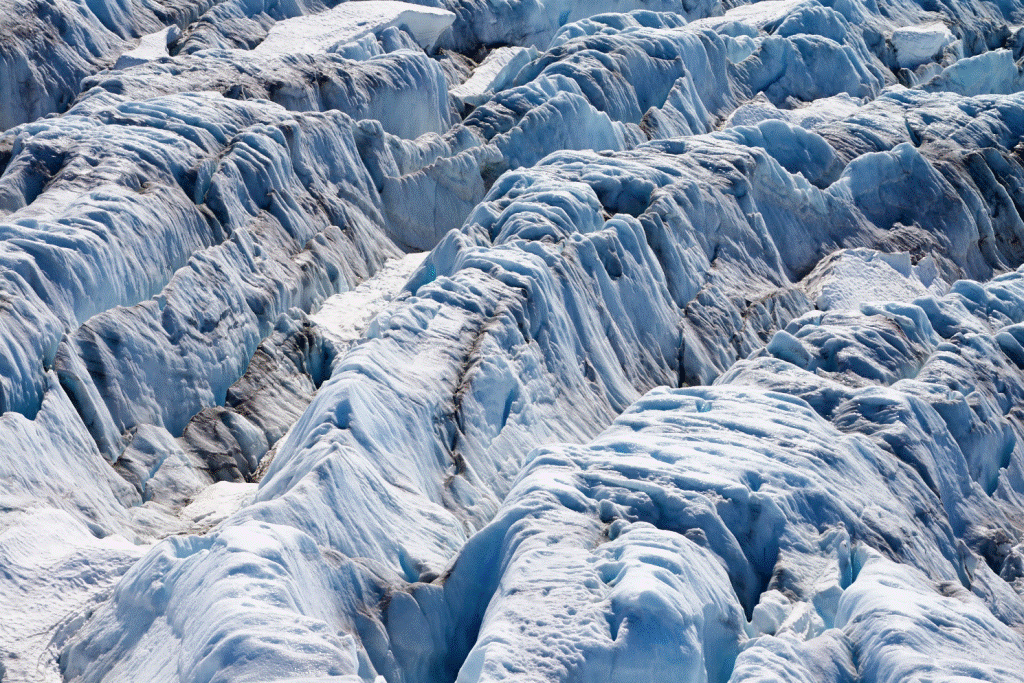
Credit: Louis Sass, USGS
As alien as Enceladus is, it is also strangely familiar.