
This article was published in Scientific American’s former blog network and reflects the views of the author, not necessarily those of Scientific American
Summer is upon us, and maybe you’re thinking this is the year you’ll finally go to Egypt to see the Great Pyramid of Giza, or Yucatan, Mexico to scale the stairs of Chichen Itza. If you’re craving an adventure a little out of the ordinary, though, why not consider these incredible off-world destinations? Elon Musk is selling tickets to the Moon, after all. It’s only a matter of time before these must-see holiday destinations will be on everyone’s bucket list!

Credit: Penguin Random House
Summer is upon us, and maybe you’re thinking this is the year you’ll finally go to Egypt to see the Great Pyramid of Giza, or Yucatan, Mexico to scale the stairs of Chichen Itza. If you’re craving an adventure a little out of the ordinary, though, why not consider these incredible off-world destinations? Elon Musk is selling tickets to the Moon, after all. It’s only a matter of time before these must-see holiday destinations will be on everyone’s bucket list!
On supporting science journalism
If you're enjoying this article, consider supporting our award-winning journalism by subscribing. By purchasing a subscription you are helping to ensure the future of impactful stories about the discoveries and ideas shaping our world today.
Mercury’s Terminator
.jpg?w=1350)
Credit: Steve Thomas
Mercury spins much slower than Earth, so its terminator line, which divides day and night, moseys along the surface at just two miles per hour (while on Earth it travels around 1,000 miles per hour at the Equator). That means you can walk leisurely along Mercury’s night side, and watch its sunrise indefinitely. Just don’t take stop for any breaks—once the sun comes up, it will surely be the end of you.
Volcanoes of Io

Credit: Steve Thomas
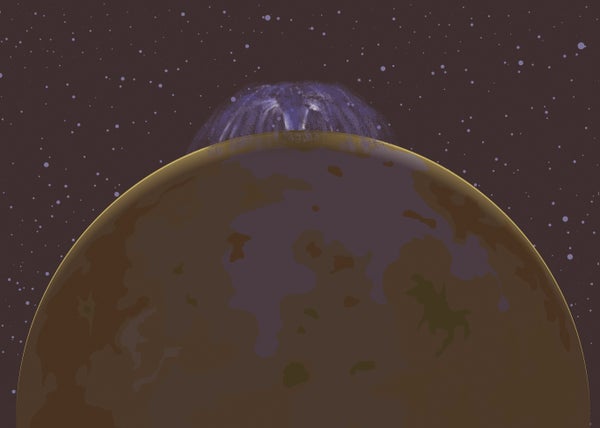
The volcanoes of Hawaii are mesmerizing, but they’ve got nothing on the volcanoes of Io. This moon of Jupiter is covered in hundreds of active volcanoes, which can heave debris hundreds of miles into the sky. Pack plenty of water, because it’s dry as hell, and don’t plan to stay too long. If the molten lava doesn’t kill you, the radiation trapped within Jupiter’s giant and powerful magnetosphere just might. But the selfies are worth it!
Saturn’s Hexagon
.jpg?w=1350)
Credit: Steve Thomas
While the rings of Saturn have long been coveted as a hot holiday spot, the hexagon at the north pole is the place most serious space vacation insiders hope to visit. Each side of this swirling storm is larger than the diameter of Earth.
Jupiter's Great Red Spot

Credit: Steve Thomas
The Great Red Spot is the most famous storm in the solar system. It’s been raging for hundreds of years—at least as long as we’ve been looking at it. Up close it’s achingly beautiful.
Pluto’s Heart

Credit: Steve Thomas
Pluto is an icy paradise, covered in frozen methane, nitrogen, and carbon dioxide - things which we usually think of as gaseous on Earth. On the southwest border of the Tombaugh region, nicknamed Pluto’s heart for its shape, you can climb the peaks of the Hillary Mountains, which rise about 5,200 above its surface. Though not as tall as Mount Everest, it’s much tougher to get to, since it’s four and a half billion miles from Earth.
If you’re out of vacation time, or you simply can’t afford a space trip this year, you can take a virtual trip to space with the Intergalactic Travel Bureau Space Vacation app (link: guerillascience.org/itbvr). Check out more of Steve Thomas’s space travel art at his website, or pick up the Vacation Guide to the Solar System.