
This article was published in Scientific American’s former blog network and reflects the views of the author, not necessarily those of Scientific American
When I first started working as a photo researcher for Scientific American MIND in 2013, a large part of my day was spent looking at brains. Lots of them. They appeared on my computer screen in various forms—from black-and-white CT scans featured in dense journals to sad-looking, grey brains sitting on the bottom of glass laboratory jars. At times they were boring, and often they could be downright disturbing.
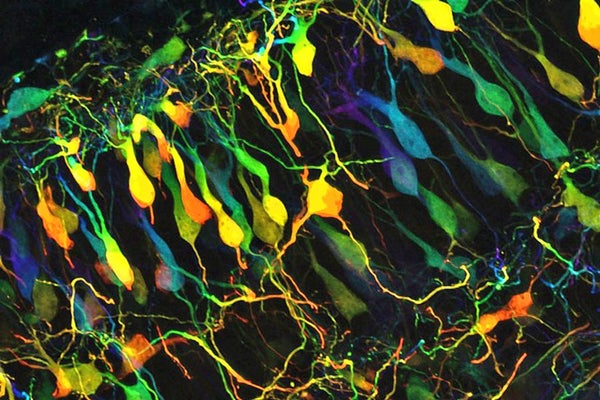
But every now and then I would come across a beautiful 3D image of strange, rainbow-colored pathways in various formations that looked like nothing I had ever seen before. I was sure it had been miscategorized somehow—no way was I looking at a brain! Through my work I have encountered countless images of multi-colored Brainbows, prismatic Diffusion Tensor Imaging (DTI), and even tiny and intricate neon mini-brains grown from actual stem cells in labs. Increasingly I have found myself dazzled, not just by the pictures themselves, but by the scientific and technological advances that have made this type of imaging possible in only the past few years.
It was through my photo research that I happened upon the Netherlands Institute for Neuroscience’s (NIN) annual Art of Neuroscience contest. This exciting opportunity for neurologists, fine artists, videographers and illustrators, whose work is inspired by human and animal brains, was something I wanted to share with our readers.
On supporting science journalism
If you're enjoying this article, consider supporting our award-winning journalism by subscribing. By purchasing a subscription you are helping to ensure the future of impactful stories about the discoveries and ideas shaping our world today.
Therefore, Scientific American is once again pleased to sponsor the 2018 Art of Neuroscience contest and would like to invite scientists and artists to submit entries representing actual neural data or tissue, that are in some way related to concepts about the brain or cognition. Please check out our 2017 slideshow for inspiration and be sure to visit NIN’s Art of Neuroscience website for details on how to enter. The deadline for entries is June 4, 2018.