
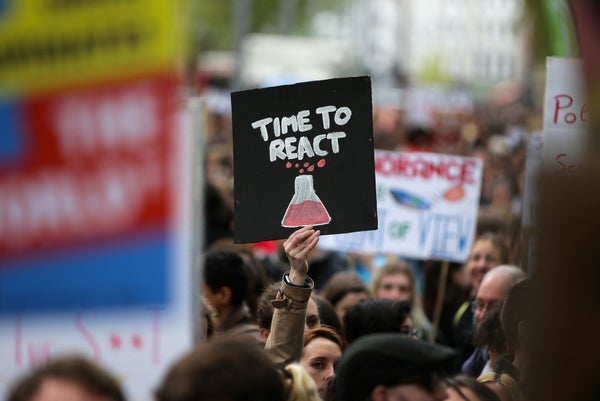
This article was published in Scientific American’s former blog network and reflects the views of the author, not necessarily those of Scientific American
“Science and everyday life cannot and should not be separated.” Rosalind Franklin
Recently, The Atlantic senior editor James Hamblin discussed how nearly all major physician organizations have spoken out publically against the Senate’s Graham–Cassidy health care bill. In fact, throughout this year’s string of health care reform bills these physician organizations have encouraged their members to engage the civic discourse, to call their representatives and so on. The fact that physicians feel compelled to pitch civic engagement as a useful “extracurricular” professional activity strikes me as odd. And it bespeaks a troubling position that has seeped into the national dialogue: science and government should be separate.
I recently posted about the U.S. Supreme Court’s decision to uphold parts of the Trump administration’s travel ban. I was critical of the order and supported my argument with data and logic. In response, I received a letter from a concerned citizen who asserted that I, as a scientist, shouldn’t meddle in politics. He declared I should stick to my test tubes and equations (as if I, as a resident in psychiatry, would know what to do with either) and leave politics to politicians. Scientist: stay in your ivory tower.
On supporting science journalism
If you're enjoying this article, consider supporting our award-winning journalism by subscribing. By purchasing a subscription you are helping to ensure the future of impactful stories about the discoveries and ideas shaping our world today.
I’d encountered this sentiment before, unfortunately within academia. At best, political activism and popular writing are not part of my job and so are not rewarded; at worst, my opinion could upset some higher-up. And yet many academics—independent of professional organizations—have begun to organize politically and to write persuasively for a popular audience, driven by a desire to contribute civically and to sculpt the national dialogue.
A large part of this desire stems from the scientific training that, in my case, accompanied my medical education. In this context, “science” is a metonym for the worldview that leads you to question and test your intuitions.
Science is rich with examples of strongly held yet demonstrably false beliefs: the practice of bloodletting or of frontal lobotomy, or perhaps prescribing opioids to sooth teething children, heroin to suppress coughs and mercury to cure syphilis—the list continues. Medicine succeeds through self-correction, via an aggressive appeal to reproducible evidence and the determination to modify action in the face of that evidence. The reason heroin is no longer used as a cough suppressant isn’t because we ran out of heroin or that it doesn’t suppress coughing—it’s because evidence showed it was harmful, and physicians acted accordingly.
Put differently, the medical community values patient care enough to spend time and money to learn whether their actions produce the intended effects. Evidence-based practice doesn’t just happen, it is sought after with elbow grease—a useful reminder for Washington.
Scientists and physicians have developed the mental habit of allowing evidence to guide their actions. Confining them to the laboratory is simply absurd. Limiting a physician’s influence on health care is poor policy, especially when the goal is to restructure a system that seeks to maximize access to quality medical care for the nation’s population.
Even worse, it’s a bad deal for the U.S. taxpayer. My education and research, for example, was heavily subsidized—at some points funded completely—by taxpayers. Across the nation, billions of tax dollars are invested each year in scientific training and research. As a return on this substantial investment, the U.S. government (not simply professional organizations) should require more civic engagement from scientists and physicians.