
This article was published in Scientific American’s former blog network and reflects the views of the author, not necessarily those of Scientific American
In 1918, World War I was raging, and the Spanish flu arrived on American shores. But the Sedition Act banned communications that might undermine the war effort, including information that might slow down the movement of people or goods.
In that political climate, “public health officials, determined to keep morale up, began to lie,” wrote John Barry in Smithsonian magazine. “Each day the disease accelerated. Each day newspapers assured readers that influenza posed no danger.” Congress repealed the Sedition Act in 1920, but the damage was done. Hundreds of thousands of people in the United States would eventually die from the disease.
Over the next century, we developed complex disease monitoring systems. We created best practices for communicating disease risk. And we invested in the independence of government agencies, empowering government experts to openly share information about public health dangers.
On supporting science journalism
If you're enjoying this article, consider supporting our award-winning journalism by subscribing. By purchasing a subscription you are helping to ensure the future of impactful stories about the discoveries and ideas shaping our world today.
The Centers for Disease Control and Prevention are now well practiced at risk communication. A 65-page manual details how the agency should communicate during a health crisis like the one we currently face. That’s why it’s so troubling that the White House has taken over communication around the coronavirus COVID-19.
While this move would be worrisome under any president, this administration creates unique challenges. Under this president, global disease surveillance systems were weakened, research programs were abandoned, and senior global health experts leftthegovernment. The president’s budget requests routinely seek extreme cuts at federal health agencies, including CDC. In the midst of this leadership vacuum, the president will say whatever he wants about virtually any topic without evidence, sometimes even contradicting the experts standing at his side.
There are echoes of 1918. The Washington Post reported that a government employee faced retaliation for raising concerns about unsafe assessment of potentially-infected individuals. The New York Times reported that public communications about the virus from CDC scientists will need “clearance.”
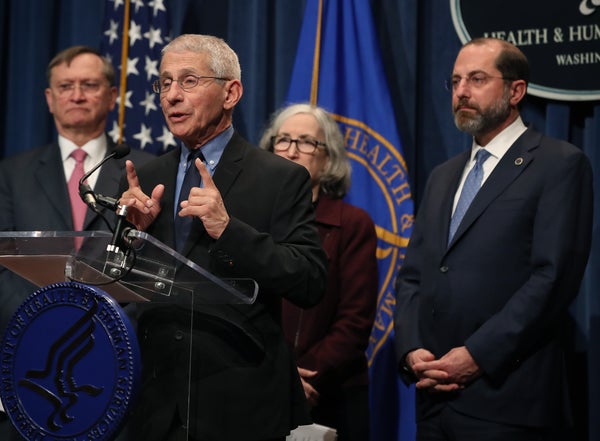
Senior NIH official and physician-scientist Anthony Fauci had to cancel several television appearances after the vice president took over the response effort. Fauci has said that he was not gagged, and we should take him at his word. But let me be clear: under no circumstances should the distribution of public health information be subject to White House or any other political clearance.
Open communication is not just good practice; it’s also policy. CDC’s (now archived) media policy puts the agency’s scientific staff in control of clearance of information. The CDC’s scientific integrity policy promotes sharing scientific information “in an open, timely, and appropriate way.”
The coronavirus is moving rapidly across the globe. Our response must be focused and clear, prioritizing public health rather than fluctuations in financial markets or political advantage. We should hear directly from the experts, not just from political appointees with a political axe to grind.
Sadly, high-ranking officials continue to confuse the public. On February 28, White House Chief of Staff Mick Mulvaney suggested the media has an agenda. “The reason you’re seeing so much attention to it today is that they think this is what’s going to bring down the president,” he told a conference audience. “That’s what this is all about.” If millions of Americans are misled about the seriousness of this threat, we’re in real trouble.
If you’ve heard Mulvaney’s name connected to science before, it may be from the SharpieGate fiasco. After the president erroneously told the public that Hurricane Dorian would hit Alabama, Mulvaney silenced scientists at the National Weather Service and forced the National Oceanic and Atmospheric Administration to put out a statement suggesting the president was right and the weather forecasters were wrong. When the science doesn’t reinforce the president’s message of the day, shut it down.
The president doesn’t even seem clear on why we have scientific experts on staff in the federal government at all. Asked about proposed cuts to CDC and other public health programs, he replied, “I'm a businessperson. I don't like having thousands of people around when you don't need them. When we need them, we can get them back very quickly.” That’s not how it works; you can’t prepare for a crisis after it’s underway.
Coordination of government action is useful and necessary, but there’s no reason for this process to become an information barrier. “[Government]-wide initiatives can work,” tweeted former United States Attorney Joyce Alene. “[I]t’s imperative Trump not politicize access to information & restore qualified personnel & expertise to succeed, as he must.”
There are no red and blue coronaviruses. The political makeup of a state will not influence whether you or your family will get sick. The politicization of information about COVID-19 will make people less trustful and compromise compliance with public health advice. And the only winner is the virus itself.