
This article was published in Scientific American’s former blog network and reflects the views of the author, not necessarily those of Scientific American
Not all supernova explosions are created equal. Scientists have recently discovered an amazing diversity of stellar deaths with a far broader variety of characteristics than they had previously supposed existed. Some supernovae, for example, are overachievers that detonate with the brightness of 100 ordinary blasts; others are underwhelming, fizzling out with hardly a flash. This strange supernova zoo is becoming clearer thanks to automated telescope surveys that can scan the entire sky on a regular basis, turning up far greater numbers of stellar eruptions than astronomers were ever able to study before.
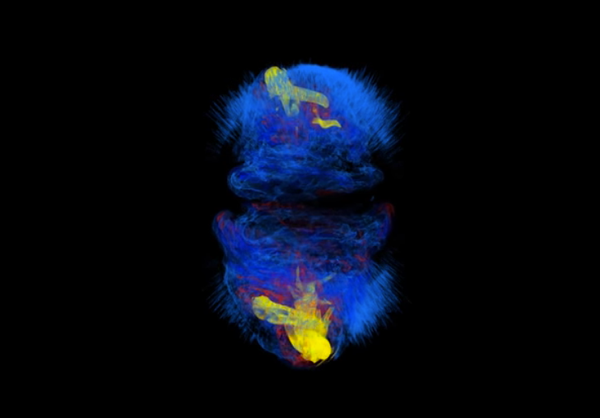
Astronomer Daniel Kasen of the University of California, Berkeley, details some of these peculiar recent discoveries in the feature “Stellar Fireworks,” appearing in the June 2016 issue of Scientific American. To give the blasts a visual twist, he has shared some computer simulations that he and his colleagues created to model what occurs inside a class of oddball supernovae born from rapidly spinning, highly magnetized neutron stars called magnetars.
On supporting science journalism
If you're enjoying this article, consider supporting our award-winning journalism by subscribing. By purchasing a subscription you are helping to ensure the future of impactful stories about the discoveries and ideas shaping our world today.
This animation shows the shock wave that results when the core of a rapidly rotating, strongly magnetized massive star collapses to form a neutron star. Funnels of highly magnetized plasma launched from the baby neutron star spread the shock front outward asymmetrically. Gases of different temperatures are depicted in different colors—blue corresponds to the coldest gas, green is hotter, and yellow and red are the hottest.
In this simulation researchers show how different processes drive the evolution of a magnetic supernova. Blue and red colors represent material that is strongly influenced by dynamics in the gas itself, whereas yellow indicates gas that is driven by magnetic fields. Instability in the magnetic fields causes this highly magnetized material to twist and bend.
This animation portrays the magnetic fields of a collapsed massive star. Yellow and red represent positive magnetic fields, and blue represents negative magnetic fields. On a timescale of just 10 milliseconds, the star’s rapid rotation revs up the strength of its magnetic field to a million billion times that of our sun.
Videos by Philipp Mösta and Sherwood Richers of the California Institute of Technology