
This article was published in Scientific American’s former blog network and reflects the views of the author, not necessarily those of Scientific American
More than a decade ago, the renowned printmaker Judith Brodsky read a story in the New York Times that listed the most important scientific questions for the coming century. “It was wonderful,” says Brodsky, a distinguished professor emerita of visual arts at Rutgers University and founder of Rutgers’ Brodsky Center for Innovative Editions. “It suggested all sorts of images to me.”
That’s how Brodsky’s work often starts—not from the visual but rather, she says, “from something I get interested in—an idea or a concept. One series of prints, for example, titled “100 Million Women are Missing,” was inspired in part by another story in the Times; it described a phenomenon in which women struggling in oppressive conditions around the world simply walk away from their lives, never to be seen again. Another, “Memoir of an Assimilated Family,” was based on photographs documenting her own family’s experiences as Jewish Americans over several generations.
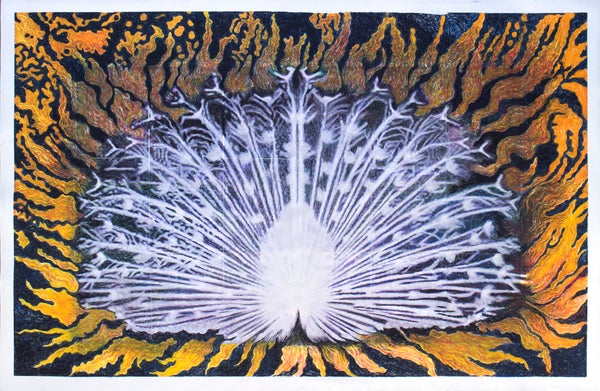
Her newest series of prints, “The Twenty Most Important Scientific Questions of the 21st Century,” follows that same pattern. As is usually the case with Brodsky’s work, her interpretation of these questions was, she says, “not literal at all. If I had to compare them to anything, I’d compare them to poetry. The latent content is more significant than the image itself—it’s what the image suggests.”
On supporting science journalism
If you're enjoying this article, consider supporting our award-winning journalism by subscribing. By purchasing a subscription you are helping to ensure the future of impactful stories about the discoveries and ideas shaping our world today.
So for example in trying to address the question “What’s the hardest problem in mathematics?” Brodsky plunged into the history of mathematics and eventually found the story of Hypatia, a prominent female mathematician and philosopher who was murdered by a mob Alexandria in about 415 A.D. For the artist, her death symbolized the terrible underrepresentation of women in math—which, in Brodsky’s interpretation, is in fact the hardest problem.
“What I’m interested in,” she says, “is the relation of science to culture, and to existence in a philosophic sense. What is its impact on our way of thinking? Which comes first, the science, or the need for a particular scientific concept? I’m interested in all of those kinds of issues. But also interested in making something that’s visually attractive. To seduce people into thinking about scientific issues in a way, perhaps, that they hadn’t thought about them before.”
For Brodsky, beautiful art isn’t necessarily about prettiness—it’s frequently about much deeper things. “That’s been true of my work every since I entered maturity as an artist,” she says. If you think about something like byzantine mosaics, they’re gorgeous, of course, but true significance isn’t in how pretty they are—it’s about death and salvation, damnation.
“So for me,” Brodsky says, “I think visual images can be something like novels. The Invisible experiences that control the visual world are more significant than the visual world itself.”