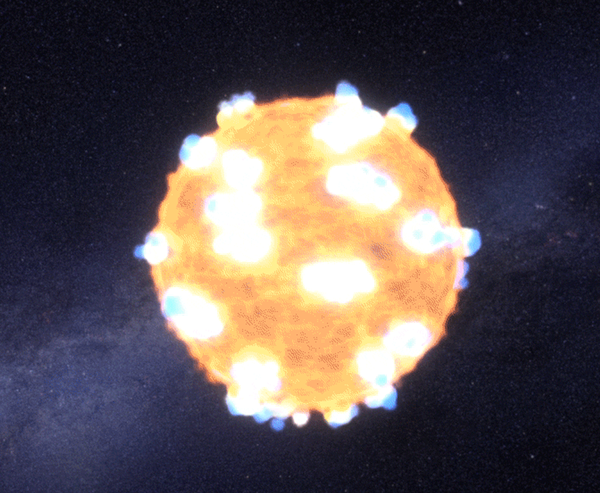
The Earliest Flash of a Supernova, Captured for the First Time

For a mission that had a near-death experience in 2013, the Kepler spacecraft continues to do some pretty amazing science

Credit: NASA Ames, STScI/G. Bacon

Join Our Community of Science Lovers!

This article was published in Scientific American’s former blog network and reflects the views of the author, not necessarily those of Scientific American


The gigantic steller explosion known as a Type 2 supernova, which happens when a massive star collapses, takes about two weeks to reach maximum brightness. At that point, it can briefly outshine an entire galaxy. But the first phase, called the 'shock breakout," takes only 20 minutes. It is a flash of light given off when photons, speeding out of the star's collapsing core, first blast through the outer surface of the star. This short-lived event has proven impossible to capture until now—but by scrutinizing Kepler images of 50 trillion stars in 500 galaxies, taken every half-hour for three years, astronomers managed to find not one, but two shock breakouts in the explosions of two red supergiant stars.

The stars were much too far away, at 700 million and 1.2 billion light-years, for Kepler to take actual images of the breakouts. By carefully analyzing the bursts of light the space telescope detected, however, artists at the NASA Ames Research Center were able to create this simulation. If you'd been in the neighborhood, this is what you might have seen—just before you were vaporized.


On supporting science journalism

If you're enjoying this article, consider supporting our award-winning journalism by subscribing. By purchasing a subscription you are helping to ensure the future of impactful stories about the discoveries and ideas shaping our world today.


But that's not all! In May, 2015 Kepler spotted another an entirely different type of supernova in a scan of 400 galaxies. Known as a Type Ia, this happens when a tiny white dwarf star sucks in matter from an orbiting companion—and when the incoming matter adds up to a critical mass, the white dwarf disappears in a massive thermonuclear explosion. Here's how NASA visualizes it.


Eliene Augenbraun is a multimedia science producer, formerly Nature Research's Multimedia Managing Editor and Scientific American's senior video producer. Before that, she founded and ran ScienCentral, an award-winning news service providing ABC and NBC with science news stories. She has a PhD in Biology.

More by Eliene Augenbraun

It’s Time to Stand Up for Science

If you enjoyed this article, I’d like to ask for your support. Scientific American has served as an advocate for science and industry for 180 years, and right now may be the most critical moment in that two-century history.

I’ve been a Scientific American subscriber since I was 12 years old, and it helped shape the way I look at the world. SciAm always educates and delights me, and inspires a sense of awe for our vast, beautiful universe. I hope it does that for you, too.

If you subscribe to Scientific American, you help ensure that our coverage is centered on meaningful research and discovery; that we have the resources to report on the decisions that threaten labs across the U.S.; and that we support both budding and working scientists at a time when the value of science itself too often goes unrecognized.

In return, you get essential news, captivating podcasts, brilliant infographics, can't-miss newsletters, must-watch videos, challenging games, and the science world's best writing and reporting. You can even gift someone a subscription.

There has never been a more important time for us to stand up and show why science matters. I hope you’ll support us in that mission.

Thank you,

David M. Ewalt, Editor in Chief, Scientific American

Subscribe