
This article was published in Scientific American’s former blog network and reflects the views of the author, not necessarily those of Scientific American
In 1984 when President Reagan directed NASA to build a permanently occupied space station, no one could have predicted the critical role it would play in human space exploration nearly four decades later.
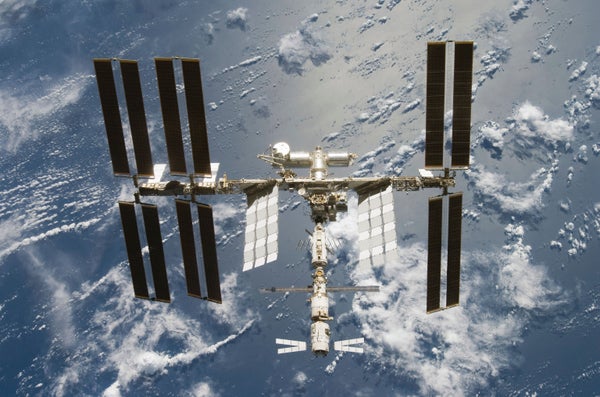
The International Space Station (ISS) took 12 years to build with support from 16 nations and has been populated continuously since November 2000. A colossal achievement by any measure—the station weighs a million pounds and is the single most expensive object ever built. And it should be.
Truly a jewel in the crown of human achievement, the ISS gave the U.S. and its partners an operational outpost in the most austere environment ever known.
On supporting science journalism
If you're enjoying this article, consider supporting our award-winning journalism by subscribing. By purchasing a subscription you are helping to ensure the future of impactful stories about the discoveries and ideas shaping our world today.
Over its lifespan, more than 2,400 experiments have been conducted by more than 230 visitors from 18 countries. The station's crew have logged over 1,300 extravehicular activity (EVA) hours on more than 217 spacewalks. Over their lifetime, teenagers have seen a constant revolution in technology, some of it exclusively the result of space access and research.
But this marvel of innovation has not always had the support it deserves.
Since the high point of the Apollo program, NASA endured criticism for being too focused on sustaining the space shuttle at the expense of deep-space exploration. Not surprisingly, political support and funding atrophied as a result. Indeed, in 1993 the station came a mere one vote away from termination in the House of Representatives.
And yet, while few were watching since the shuttle stood down in 2011, a new and reinvigorated agency is emerging with a vision that should captivate even the cynics. Under Space Policy Directive 1 (SPD-1), NASA and the ISS National Laboratory are accelerating the nation's push into commercial space. With an expected trillion-dollar space economy to come, the ISS can play a defining role in the formation of the industry.
Aboard the ISS, an array of basic and applied research programs are underway with participation of companies such as Boeing, Anheuser-Busch, Sanofi, LambdaVision, Space Tango, Airbus, and Teledyne Brown Engineering. The ISS is effectively the premier space R&D lab, and companies are utilizing microgravity at the edge of the human frontier 250 miles up to solve problems here on Earth.
Beyond the major policy shift announced in June to allow for greater commercial partnerships aboard ISS, other major milestones are underway. Last month, NASA and Boeing assembled 80 percent of the massive core stage needed to launch the Space Launch System and Orion on their first mission to the Moon: Artemis 1.
Notably, NASA's "new" charge to facilitate and encourage the commercial sector is nothing new. After all, NASA has fostered some of the greatest technological developments in all of human history. And later this year, NASA's Commercial Crew transport will launch from Cape Canaveral to resupply the ISS.
But no one should take for granted the colossal task of maintaining this orbital toehold. Despite being sheltered within our planet's magnetic shield, the ISS has endured a battering equivalent to an aircraft carrier in World War II's Battle of Midway. Shuttle veteran Alvin Drew recounted to the U.S. Chamber of Commerce a year ago his EVA experience with razor sharp ISS exterior surfaces because of the sandblasting effect of the low Earth orbit environment.
Just maintaining the operational status of the station alone is an achievement. Over the decades NASA and Boeing, as prime contractor, have stretched and maximized the platform as a test bed to fully evolve our understanding of microgravity's effect on metabolic systems. Humans are fragile after all. But SPD-1 boldly charts out human exploration to the Moon, Mars and beyond.
With ISS as its point of departure, NASA's recently announced Lunar Gateway program will be the platform to prepare and propel humans to Mars. To paraphrase Administrator James Bridenstine, Gateway will be the permanent lunar command module.
And in 2024 Gateway will facilitate the mission objective of Artemis 1 to land astronauts near the Lunar South Pole. But we can't get there from here—not without the ISS. The lion's share of onboard station research is aimed at solving long-term challenges for human survival in deep space. The ISS is the tethered ship from which astronauts will hone spacefaring skills to venture beyond the proverbial horizon.
In this new era of exploration, the ISS is allowing the right questions to be asked and answered. One could say that, to date, we have been consumed with identifying the limitations inherent in humanity's reach into space. Yet recently, we have begun to ask a more nuanced and intriguing question: What are the unique characteristics of the domain beyond Earth that we can use for our benefit?
Although the future of deep-space exploration is no more known today than it was in 1984, all that is certain is the ISS will be the launch pad for wherever humans go from here.