

This article was published in Scientific American’s former blog network and reflects the views of the author, not necessarily those of Scientific American
At a recent group meeting, my postdoc raised a question: “Should we make our theoretical model more complex so that our explanation of the data will not appear too trivial?” I was surprised by this suggestion and felt obligated to explain why. “Simplicity is a virtue,” I said, “not a deficiency. Excessive mathematical gymnastics is used to show off in branches of theoretical physics that have scarce experimental data. But as physicists, we should seek the simplest explanation for our data. This is the lifeblood of physics and the appropriate measure of success.”
For decades, it was believed that our simple model of the early universe, characterized by a small number of parameters, was naive and the result of scarce data. By the turn of the 21st century, we had collected enough to verify that the universe indeed started from the simplest possible initial state, being nearly homogeneous and isotropic with small fluctuations that developed into the complex structures we find in it today. This simple cosmological model, which has existed for a century, is the foundation for modern cosmology.
In today’s fierce job market, fledgling scientists sometimes attempt to impress their senior colleagues with lengthy derivations marked by challenging mathematical complexity. Another postdoc told me recently: “The most fashionable trend for demonstrating exceptional skills in my research field involves writing extensive papers, sometimes hundreds of pages long, or longer. I am facing the strategic dilemma of choosing between two options for my future career: long complicated projects or short insightful papers?”
On supporting science journalism
If you're enjoying this article, consider supporting our award-winning journalism by subscribing. By purchasing a subscription you are helping to ensure the future of impactful stories about the discoveries and ideas shaping our world today.
It is clear that accomplishing long projects requires more sweat; but is science supposed to be hard labor? Not necessarily. Our task as scientists is to explain phenomena based on the simplest theory whose predictions can be tested further by new experiments. And in the spirit of Occam’s razor, if the answer is simple, why make it complicated?
Long-term, predictable projects may attract the attention of a funding agency by forecasting what they may find, but their legacy could be less influential than short reports of unexpected results. Long discussions are read by fewer readers and so naturally their appreciation tends to be superficial. On the other end of the spectrum, an accessible short insight tends to stimulate follow-up work by the broad scientific community. The wider appeal of brief, intellectually rich reports improves job prospects, contrary to naive expectations.
The trendy attraction to complexity is shared by senior scientists who wish to make their work nuanced and less accessible to scrutiny. Although sophistication is often valued as a trademark of the elite, science is better served if its results are expressed in simple and transparent terms. When asked by reporters: “How do you manage to explain your research so clearly?” I often reply: “By describing only things that I understand and admitting what I do not know.” Complexity is sometimes used as theatrical smoke and fog to obscure the unflattering image of ignorance.
The physicist Richard Feynman said: “Just as a poet often has license from the rules of grammar and pronunciation, we should like to ask for ‘physicists' license’ from the rules of mathematics in order to express what we wish to say in as simple a manner as possible.” Indeed, the original PhD thesis of Louis de Broglie, which established the wave-particle duality in quantum mechanics, was short and simple and earned him the Nobel Prize just five years later.
Simple insights can occur instantly, without hard labor, and lead to an exhilarating feeling that the mathematician Henri Poincaré called “sudden illumination”. When Julian Schwinger and Richard Feynman suggested two different approaches to explain experimental data in the field of quantum electrodynamics, it appeared mathematically complicated to decide which one should be used until Freeman Dyson, then just 24, demonstrated elegantly that they were equivalent. Freeman had the simplifying insight on a Greyhound bus ride and afterwards said: “It is impossible for me to judge whether the work is as great as I think it may be. All I know is, it is certainly the best thing I have done yet.” He was rewarded with a permanent faculty appointment at the Institute for Advanced Study in Princeton, alongside Albert Einstein. Both Feynman and Schwinger shared the Nobel Prize thanks to this simplifying revelation.
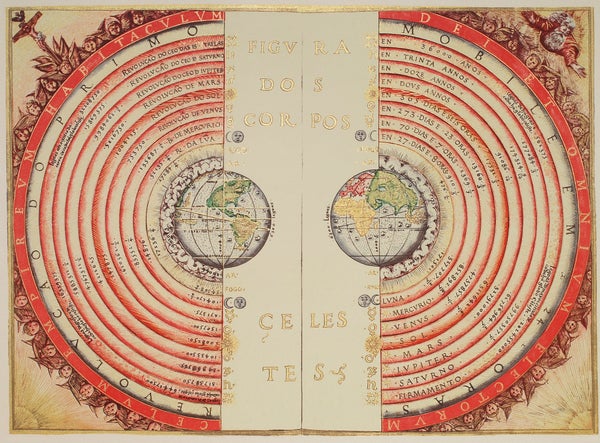
Unwarranted complexity often requires the fine tuning of parameters. The more fine-tuned a theory is, the less explanatory power it has relative to the simpler truth. A classic example is the mathematically sophisticated Ptolemaic theory of epicycles for describing the motion of planets, as compared to the simpler Newtonian alternative. The same reservation should apply when cosmologists reverse-engineer flexible theories like cosmic inflation or the multiverse by introducing new free parameters to fit new data. This point was quantified in a recent paper that I wrote with Feraz Azhar, a philosophy postdoctoral fellow at Harvard’s Black Hole Initiative, who just fulfilled his job-market aspirations by accepting a junior faculty position while formulating this idea.
Although simple insights appear trivial in retrospect, discovering them is a rare privilege. Complex arguments which are born after tedious labor can be regarded as fruits that are in plain sight but difficult to reach. Rare insights, on the other hand, are low-hanging fruits often hidden from view. These two options are the only ones left when all the visible low-hanging fruits are already picked up.