
This article was published in Scientific American’s former blog network and reflects the views of the author, not necessarily those of Scientific American
In July 1958, an astronomer at the University of Wisconsin–Madison named Arthur “Art” Code received a telegram from the fledgling Space Science Board of the National Academy of Sciences. The agency wanted to know what he and his colleagues would do if given the opportunity to launch into Earth’s orbit an instrument weighing up to 100 pounds.
Code, newly-minted director of the University’s Washburn Observatory, had something in mind. His department was already well known for pioneering a technique for measuring the light emitted by celestial objects, called photoelectric photometry, and Code had joined the university with the intent of adapting it to the burgeoning field of space astronomy.
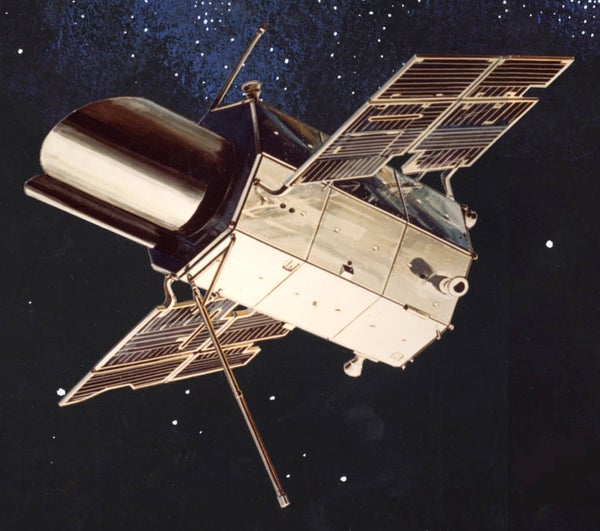
He founded the Space Astronomy Laboratory at UW–Madison and, with his colleagues, proposed to launch a small telescope equipped with a photoelectric photometer, designed to measure the ultraviolet (UV) energy output of stars—a task impossible from Earth’s surface. Fifty years ago, on December 7, 1968, that idea culminated in NASA’s launch of the first successful space-based observatory: the Orbiting Astronomical Observatory, or OAO-2.
On supporting science journalism
If you're enjoying this article, consider supporting our award-winning journalism by subscribing. By purchasing a subscription you are helping to ensure the future of impactful stories about the discoveries and ideas shaping our world today.
With it was born the era of America’s Great Observatories, bearing the Hubble, Spitzer, Chandra and Compton space telescopes, a time during which our understanding of the universe repeatedly deepened and transformed. Today, dwindling political appetite and lean funding threaten our progress. Contemporary projects like the James Webb Space Telescope flounder, and federal budgets omit promising projects like the Wide Field Infrared Survey Telescope (WFIRST).
In celebrating the half century since OAO-2’s launch, we are reminded that major scientific achievements like it become part of the public trust, and to make good on the public trust, we must repay our debt to history by investing in our future. Advances like those made by Hubble are possible only through sustained, publicly-funded research.
These first investments originated in the late 1950s, during the space race between the U.S. the USSR. They led to economic gains in the private sector, technological and scientific innovations, and the birth of new fields of exploration.
Astronomer Lyman Spitzer, considered the father of the Hubble Space Telescope, first posited the idea of space-based observing seriously in a 1946 RAND Corporation study. By leaving Earth’s atmosphere, he argued, astronomers could point telescopes at and follow nearly anything in the sky, from comets to galaxy clusters, and measure light in a broader range of the electromagnetic spectrum.
When Code pitched Wisconsin’s idea to the Space Board, the result was NASA funding to create part of the scientific payload for OAO. The agency went to work planning a spacecraft that could support these astronomical instruments. The Cook Electric Company in Chicago and Grumman Aircraft Engineering Corporation in New York won contracts to help pull it off.
The payload, named the Wisconsin Experiment Package (WEP), bundled five telescopes equipped with photoelectric photometers and two scanning spectrophotometers, all with UV capabilities. The Massachusetts Institute of Technology created a package of X-ray and gamma detectors.
Scientists and engineers had to make the instruments on OAO both programmable and capable of operating autonomously between ground contacts. Because repairs were impossible once in orbit, they designed redundant systems and operating modes. Scientists also had to innovate systems for handling complex observations, transmitting data to Earth digitally (still a novelty in those days), and for processing data before they landed in the hands of astronomers.
The first effort, OAO-1, suffered a fatal power failure after launch in 1966, and the scientific instruments were never turned on. But NASA reinvested, and OAO-2 launched with a new WEP from Wisconsin, and this time a complementary instrument from the Smithsonian Astrophysical Observatory, called Celescope, that used television camera technology to produce images of celestial objects emitting UV light. Expected to operate just one year, OAO-2 continued to make observations for four years.
Numerous “guest” astronomers received access to the instruments during the extended mission. Such collaborations ultimately led to the creation of the Space Telescope Science Institute, which Code helped organize as acting director in 1981.
And the data yielded many scientific firsts, including a modern understanding of stellar physics, surprise insights into stellar explosions called novae, and exploration of a comet that had far-reaching implications for theories of planet formation and evolution.
To be responsible beneficiaries of such insights, we must remember that just as we are yesterday’s future, the firsts of tomorrow depend on today. We honor that public trust only by continuing to fund James Webb, WFIRST, and other projects not yet conceived.
In the forward of a 1971 volume publishing OAO-2’s scientific results, NASA’s Chief of Astronomy Nancy G. Roman wrote: “The performance of this satellite has completely vindicated the early planners and has rewarded … the entire astronomical community with many exciting new discoveries and much important data to aid in the unravelling of the secrets of the stars.”
Let’s keep unraveling these stellar secrets.