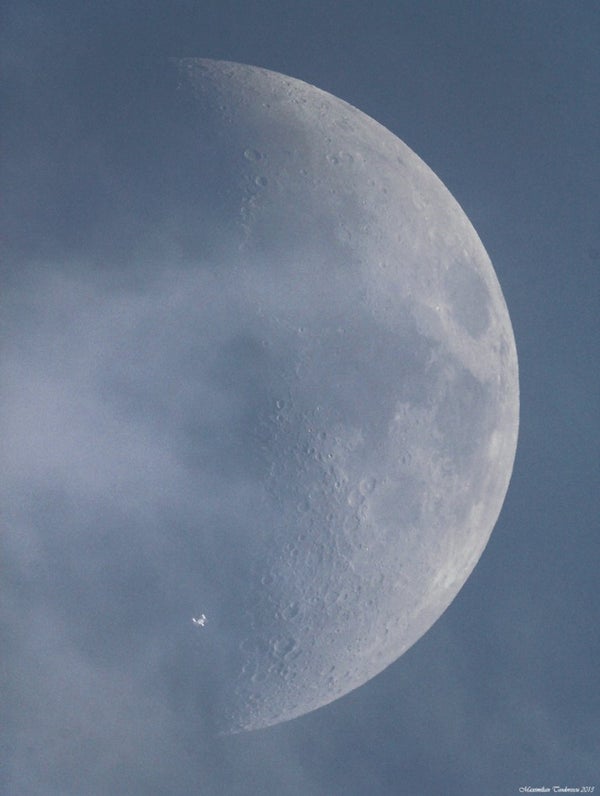
The Transit of the ISS Enterprise

It’s no secret: Overthinking It loves Star Trek. We have already thought way too hard about how Benedict Cumberbatch could crush your skull, and how the most resilient little animal on the planet could fix a warp core.

Join Our Community of Science Lovers!

This article was published in Scientific American’s former blog network and reflects the views of the author, not necessarily those of Scientific American


It’s no secret: Overthinking It loves Star Trek. We have already thought way too hard about how Benedict Cumberbatch could crush your skull, and how the most resilient little animal on the planet could fix a warp core. We love Star Trek because it uses fiction to advance a humanistic vision of the future. It adds positively to reality. So, when reality can give back to Star Trek, we perk up.

Below, photographer Maximilian Teodorescu from Romania captured the International Space Station silhouetted against the Moon in broad daylight–a wonderful shot that looks surprisingly like the transit of the ISS Enterprise.


On supporting science journalism

If you're enjoying this article, consider supporting our award-winning journalism by subscribing. By purchasing a subscription you are helping to ensure the future of impactful stories about the discoveries and ideas shaping our world today.


In a transit across the Moon, the ISS Enterprise may not be going at warp speed, but it sure is going fast. Orbiting the Earth at nearly eight kilometers per second, the ISS carries enough kinetic energy to simulate three kilotons of TNT or 15 percent of the energy one gram of matter gets from Einstein’s famous equation (or maybe a photon torpedo). Even if the pictured spacecraft is not really piloted by Kirk or Picard, shots like these are a reminder that science fiction has some basis in fact–a way to nerd out about reality. We actually have a ship in space, exploring the final frontier!

Like Neil deGrasse Tyson says, “keep looking up,” and you’ll probably find something amazing.

Image Credit:

ISS Transit Over The Moon by Maximilian Teodorescu

Kyle Hill is a science communicator who specializes in finding the secret science in your favorite fandom. He has a bachelor's degree in environmental engineering and a master's degree in communication research (with a focus on science, health, and the environment) from Marquette University in Milwaukee, Wisconsin.
Aside from co-hosting Al Jazeera America's science show, TechKnow, Hill is also a freelancer who has contributed to Wired, Nature Education, Popular Science, Slate, io9, Nautilus, and is a columnist for Skeptical Inquirer. He manages Nature Education's Student Voices blog, is a research fellow with the James Randi Educational foundation. Email: sciencebasedlife@gmail.com

More by Kyle Hill

It’s Time to Stand Up for Science

If you enjoyed this article, I’d like to ask for your support. Scientific American has served as an advocate for science and industry for 180 years, and right now may be the most critical moment in that two-century history.

I’ve been a Scientific American subscriber since I was 12 years old, and it helped shape the way I look at the world. SciAm always educates and delights me, and inspires a sense of awe for our vast, beautiful universe. I hope it does that for you, too.

If you subscribe to Scientific American, you help ensure that our coverage is centered on meaningful research and discovery; that we have the resources to report on the decisions that threaten labs across the U.S.; and that we support both budding and working scientists at a time when the value of science itself too often goes unrecognized.

In return, you get essential news, captivating podcasts, brilliant infographics, can't-miss newsletters, must-watch videos, challenging games, and the science world's best writing and reporting. You can even gift someone a subscription.

There has never been a more important time for us to stand up and show why science matters. I hope you’ll support us in that mission.

Thank you,

David M. Ewalt, Editor in Chief, Scientific American

Subscribe