
This article was published in Scientific American’s former blog network and reflects the views of the author, not necessarily those of Scientific American
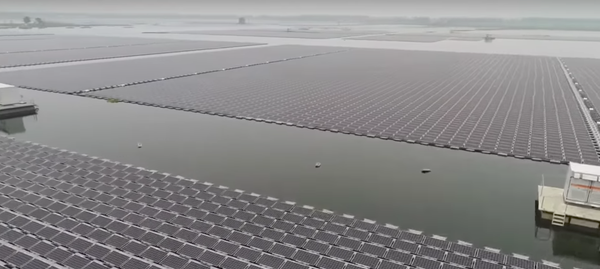
The world’s largest floating solar farm is now generating electricity atop a former coal mine in China, according to The China Daily’s reports. More than six times the capacity of the previous record holder, the farm’s solar panels cover the equivalent area of more than 160 football fields as they float on top of the freshwater runoff that has filled the former mine.
The solar farm includes 120,000 solar panels with a total capacity of 40 Megawatts. This is more than three times the capacity of the mega-project under construction by Kyocera Corp. in Japan’s Chiba Prefecture that is expected to come online in 2018. It is also six times larger than the previous record holder – the 6.3 Megawatt (23,000 solar panels) floating solar farm on the Queen Elizabeth II reservoir in the United Kingdom, which powered up in 2016.
Located in Huainan, a coal-rich city in eastern China’s Anhui Province, the project cost a reported $45 million ($1.13 per Watt).
On supporting science journalism
If you're enjoying this article, consider supporting our award-winning journalism by subscribing. By purchasing a subscription you are helping to ensure the future of impactful stories about the discoveries and ideas shaping our world today.
Check out this aerial tour of the solar farm that was taken using a drone and is complemented by some bits of narration and electronic music:
Earlier this month, the U.S. Energy Information Administration released its 2017 International Energy Outlook. According to their analysis, after a rapid expansion since the turn of the century, China’s use of coal to produce electricity is now expected to flatten and then decline in the coming decades as they increasingly use renewable energy resources.

Furthermore, due in large part to rising concerns over air pollution, a total 150 Gigawatts (GW) of new coal power plant capacity in China has been canceled or postponed. An additional 20 GW of older coal capacity is expected to be retired while upgrades are anticipated for the remaining 1,000 GW of coal power found across China in order to improve their operation and reduce emissions.
