


This article was published in Scientific American’s former blog network and reflects the views of the author, not necessarily those of Scientific American
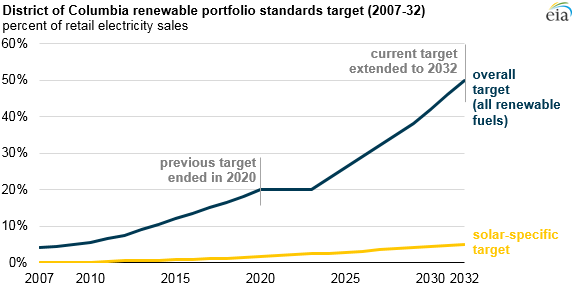
This summer the District of Columbia expanded and extended its renewable portfolio standard (RPS) target under the Renewable Portfolio Standard Expansion Amendment Act of 2016. This amendment to the original 2004 Act included:
an increase in the District’s RPS from 20% by 2020 to a new target of 50% by 2032
an increase in the solar-specific target of 2.5% by 2023 to 5% by 2032
Visually, this increase looks like the following graphic prepared by the U.S. Energy Information Administration (EIA).
On supporting science journalism
If you're enjoying this article, consider supporting our award-winning journalism by subscribing. By purchasing a subscription you are helping to ensure the future of impactful stories about the discoveries and ideas shaping our world today.

Source: U.S. Energy Information Administration, based on the District of Columbia's Renewable Portfolio Standard Expansion Amendment Act of 2016 (DC Act 21-466)
According to the EIA, the District of Columbia has met its overall target each year since 2009 but has often come up short of its solar ambitions.
To date, the District has met its targets using renewable sources located in neighboring states due to a lack of utility-scale renewable electricity generators within its borders. A total of 19 states outside of D.C. have renewable capacity that can be counted toward the District’s RPS targets.
About half of this approved capacity being found in three states - Illinois, Indiana, and Pennsylvania – and is dominated by wind power.

Source: U.S. Energy Information Administration, based on District of Columbia Public Service Commission, Report on the Renewable Energy Portfolio Standard for Compliance Year 2015
A total of 29 states and 3 territories in the United States also have Renewable Portfolio Standards according to the DSIRE database at N.C. State University. An additional 8 states and 1 territory have set renewable portfolio goals.