
This article was published in Scientific American’s former blog network and reflects the views of the author, not necessarily those of Scientific American
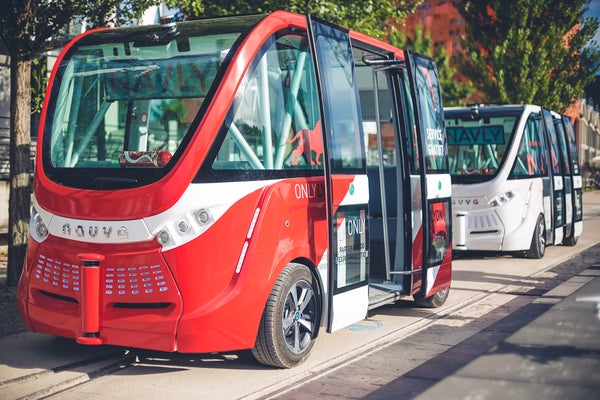
The City of Lyon in eastern France has brought a driverless shuttle service to its streets, according to an announcement made earlier this month. These battery-powered minibuses are integrated into the city’s broader public transport network and will initially operate for a year-long trial.
The shuttles travel along a 1,350 meter (0.8 mile) circular route with five regular stops. This route is located in the Confluence district in the 2nd borough in Lyon and is free of stop lights, crosswalks, or intersections.
Each shuttle carries up to 15 people for free along the route, using a number of navigation technologies to steer along the route and avoid obstacles including:
On supporting science journalism
If you're enjoying this article, consider supporting our award-winning journalism by subscribing. By purchasing a subscription you are helping to ensure the future of impactful stories about the discoveries and ideas shaping our world today.
LiDAR
sterovision cameras
real-time kinematic GPS
odometry: data from motion sensors
Manufactured by Navaya, these shuttles have a top speed of 45 kilometers (29 miles) per hour and do not have a steering wheel or pedals. However, these vehicles are capped at 20 km/h (13 mpg) during the trial period. They also carry a human operator at all times.
This project is supported by the French Agency for Environment and Energy as well as the French Ministry of Ecology, Sustainable Development and Energy.