
This article was published in Scientific American’s former blog network and reflects the views of the author, not necessarily those of Scientific American
Today, buildings account for 40% of the energy consumed in the U.S. each year. However, since the 1980s, the real cost of energy has increased more than fivefold, leading to greater awareness of energy use and its resulting environmental impact. This leaves a significant opportunity area for green building retrofits, particularly in building HVAC systems.
‘Green building’ methods use design and construction techniques to reduce the energy use and corresponding environmental impact of buildings. These methods emphasize designing a properly sized and oriented structure, in addition to using recycled and sustainably sourced materials. While many think of green building in terms of new construction (for example, with the U.S. Green Building Council's LEED initiatives), there is a vast stock of existing structures that can be made more efficient through building energy retrofits. These retrofits can be used first to reduce energy demand from these buildings, and then to help supply the remaining energy demand through renewable resources.
In Texas buildings, air-conditioning is responsible for 35 – 45% of the total annual electricity use, making it the single greatest consumer of electricity. In turn, it is one of the prime targets for green building retrofits. A focused energy retrofit should not only increase the efficiency of any HVAC equipment, but also decrease the amount of load on the air conditioner itself. By decreasing the amount of heat that needs to be removed from the building – defined as the building cooling load - HVAC equipment can be downsized as well, substantially lowering the building’s total energy consumption, as well as peak power draw. This can, in turn, help to minimize the building’s overall energy use and environmental impact.
On supporting science journalism
If you're enjoying this article, consider supporting our award-winning journalism by subscribing. By purchasing a subscription you are helping to ensure the future of impactful stories about the discoveries and ideas shaping our world today.
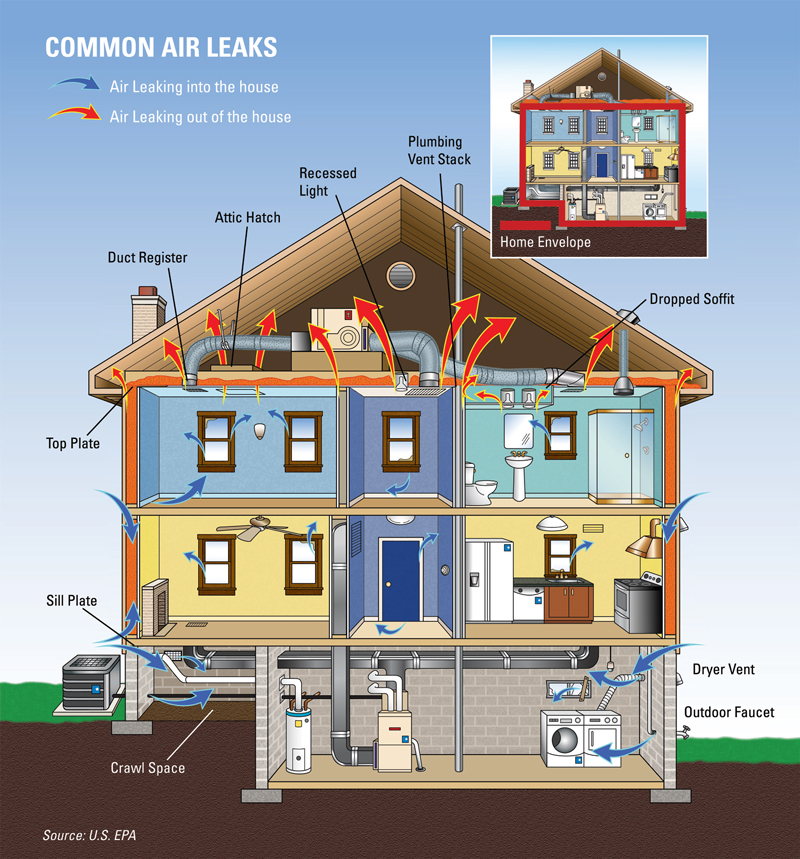
Approaches to decreasing the cooling load of a particular building can vary with the building size and use. For residential houses, increasing the insulation levels and reducing the amount of outside air infiltration into the home by sealing the building envelope is often the first (very effective) step. However, care much be taken to insure that there is at least a minimum level of ventilation to the inside space, otherwise occupants may experience adverse health effects due to poor indoor air quality. For large buildings, the heat generated by lights, electronics, and even people contributes significantly to the cooling load, and as a result energy efficient lighting and electronics can have a significant impact on energy use.
Additionally, inspecting and repairing building air ducts, which are notoriously leaky, can often reduce the building-cooling load. In a recent study of homes in Austin, it was found that the average duct system loses about 20% of its airflow, significantly reducing HVAC system performance. Effective duct sealing, or better, running ducts inside the conditioned space can lead to significant energy savings. Also, by running ducts within an air conditioned space, any insulation applied in attic space can be more effective, due to fewer penetrations of the ceiling and the resulting increase in attic insulation uniformity.
There are many other improvements that can be made outside of the HVAC system in order to reduce cooling load. For example, low-e and reflective windows can be used on the south and west sides of the buildings, which have the most direct solar gain, with less expensive clear double paned windows on the north and east sides of the building, where conduction is the major contributor to building cooling load. By balancing the cost of the windows with the potential savings, this option can be a more economic option for reducing the energy needs of larger buildings.
While existing buildings might not be as efficient as newly constructed facilities initially, green building retrofits can help to improve the energy efficiency of these structures. These improvements can provide many environmental and economic benefits by reducing the energy requirements of these buildings.
Contributing to this post were Charles R. Upshaw (a PhD student in Mechanical Engineering) & Joshua D. Rhodes (a PhD student in Civil Engineering). Both are members of the Webber Energy Group at The University of Texas at Austin.
Photo Credit:
1. Photo of downtown Boston at night by Kevin Lawver and used under this Creative Commons license.
2. Graphic of common air leaks in homes from the U.S. Environmental Protection Agency's Energy Star website.
[A similar version of this post was published in September 2011 in Construction News – a Texas statewide newspaper.]