
This article was published in Scientific American’s former blog network and reflects the views of the author, not necessarily those of Scientific American
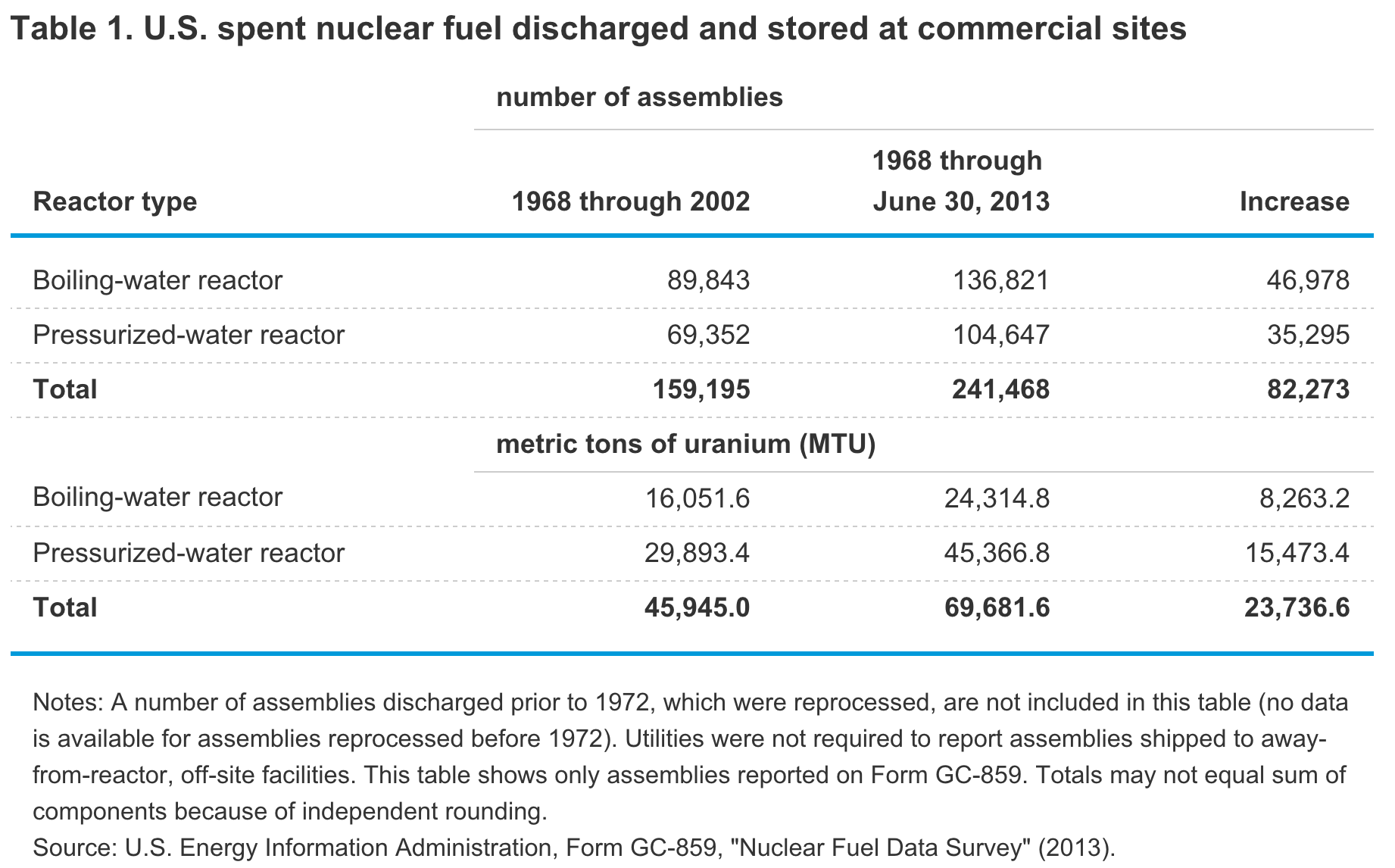
The amount of spent nuclear fuel stored at commercial sites in the United States has increased by more than 50% since 2002, according to a new dataset from the U.S. Energy Information Administration (EIA).
All told, the U.S. nuclear power plant fleet discharged and stored an estimated 45.9 thousand metric tons of uranium (MTUs) at commercial sites between 1968 and 2002. This value increased by 23.7 thousand MTUs (51%) to a total of 69.9 thousand MTUs between 2002 and 2013.
Note: the proposed Yucca Mountain long-term storage facility would store 70 thousand MTUs of spent fuel.
On supporting science journalism
If you're enjoying this article, consider supporting our award-winning journalism by subscribing. By purchasing a subscription you are helping to ensure the future of impactful stories about the discoveries and ideas shaping our world today.
This spent fuel was produced in nuclear power plants across the country. The nation current houses ninety-nine (99) nuclear reactors across sixty-one power plants in 30 states. The majority of these power plants are located in the eastern half of the continental US. Just three western states – Arizona, California, and Washington – currently have operating nuclear reactors.

Photo Credit: U.S. Nuclear Regulatory Commission (NRC), “Operating Nuclear Power Reactors (by Name or Location)”
These nuclear power plants are responsible for almost one-fifth (19%) of the electricity produced in the United States each year. This is more than all of the electricity currently produced by renewables – including hydro (6%), wind (4.4%), biomass (1.7%), solar (0.4%), and geothermal (0.4%).

Credit: Chart by Melissa C. Lott using EIA data
The long-term plan for spent nuclear fuel has been to collect it in a centralized location. In 1982, the Nuclear Waste Policy Act directed the U.S. Department of Energy (DOE) to site, construct, and operate this type of long-term repository. Five years later, the DOE was directed to focus its work on developing Nevada’s Yucca Mountain for this purpose. However, its development has stalled and the DOE is now pursuing a “consent-based” waste site strategy to find an alternative site for long-term waste storage.