
This article was published in Scientific American’s former blog network and reflects the views of the author, not necessarily those of Scientific American
Offshore wind is being used to produce electricity for the first time in the United States and federal leases of land for new facilities is booming along the east coast.
Earlier this month, the Block Island Wind Farm off the coast of Rhode Island began to deliver electricity to the nearby island community. The 30 megawatt (MW) wind farm consists of five General Electric turbines that are capable of powering almost 17,000 homes. While this amount of electricity is the equivalent of roughly ~1 percent of the state’s annual demand for electricity, it represents 90 percent of the island’s needs. According to Rhode Island Senator Sheldon Whitehouse:
“This is a historic milestone for reducing our nation’s dependence on fossil fuels, and I couldn’t be more thrilled that it’s happening here in the Ocean State.”
On supporting science journalism
If you're enjoying this article, consider supporting our award-winning journalism by subscribing. By purchasing a subscription you are helping to ensure the future of impactful stories about the discoveries and ideas shaping our world today.
According to the United States Department of Energy, federal leading of land for offshore wind has grown tremendously since 2013 when the first lease sale was completed. All told, purchased federal leases for offshore wind have topped one million acres along the east coast since 2013.

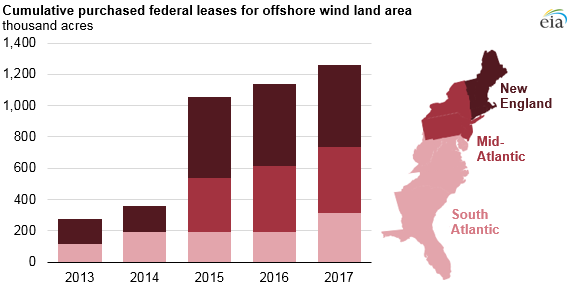
The National Renewable Energy Laboratory estimates that the United States could develop 4,200 gigawatts (GW) of offshore wind energy. The majority of this potential exists in federal waters, which extend out to 200 nautical miles (i.e. about 197 nautical miles beyond typical state water boundaries).