

This article was published in Scientific American’s former blog network and reflects the views of the author, not necessarily those of Scientific American
Texas is undeniably a principal in the oil and gas industry. The Lone Star State is also surging ahead in green electricity, boasting one-fifth of the ~68 GW of wind power currently installed in the United States. But, perhaps less known is that Texas:
is the nation’s sixth largest producer of coal.
is the nation’s leading producer of lignite coal.
produces this lignite coal exclusively in strip mines.
The American Society for Testing and Materials groups different types of coal into four ranks – anthracite, bituminous, subbituminous, and lignite. Anthracite coal has the highest amount of fixed carbon and the lowest amount of moisture of the four groups. In turn, it is the easiest to burn and has the most energy per pound of coal. At the other end of the spectrum is lignite – or “brown coal” – the type of coal currently being produced in mines across Texas.
On supporting science journalism
If you're enjoying this article, consider supporting our award-winning journalism by subscribing. By purchasing a subscription you are helping to ensure the future of impactful stories about the discoveries and ideas shaping our world today.

Coal Fields of the Conterminous United States by John Tully at the USGS
According to the University of Texas Energy Institute’s Assistant Director Dr. Fred Beach, lignite coal is essentially “brown dirt” and frequently referred to as “oil mud.” Because of its low energy-density and high moisture content, lignite coal is the least efficient type of coal to burn. However, because of its proximity to many of Texas’s coal-fired power plants, it is frequently the most economic option.
Coal-fired power plants exist in Texas where “you’re literally digging [lignite coal] out of the ground, putting it on a conveyor belt, and it’s going right into the power plant” says Beach. These mine-to-mouth power plants exist at many locations in Texas, including next door to the state’s capital city.
All told, two-fifths of coal consumption is Texas is met using locally-mined lignite coal. The rest of its demand is met using subituminous coal brought in from Wyoming.
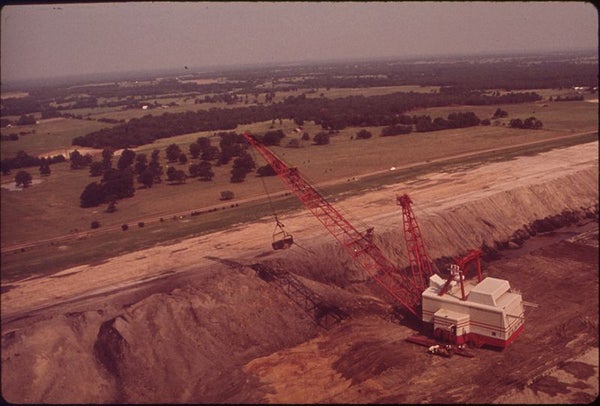
Texas lignite coal is produced exclusively via surface strip mining (also called open-pit mining). While Texas historically been produced its lignite using underground coal mining, producers began using strip mining techniques in the 1920s. According to the Texas Railroad Commission, by 1951, this method was the only one being used to produce lignite coal.
But, Texans pay more attention to renewable energy than lignite coal mining, according to The University of Texas Energy Institute’s Director Dr. Tom Edgar. In turn, “most people in Austin really have no clue that there is a strip mine located only 30 miles away from the city” says Edgar.
To listen to an August interview on NPR’s Marketplace about lignite coal in Texas – see this link.