

This article was published in Scientific American’s former blog network and reflects the views of the author, not necessarily those of Scientific American
After a successful pilot project, ABB announced this month that it would be working with Transports Publics Genevois and HESS (a Swiss bus manufacturer) to provide flash charging and on-board electric vehicle technology for a suite of 12 e-buses to serve this route.
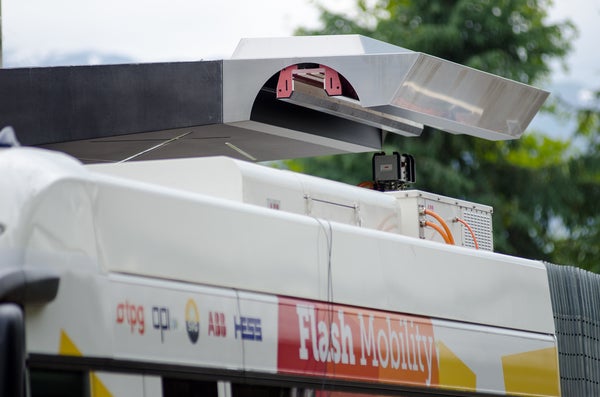
The goal of the “flash charging” process is to take advantage of the downtime that buses have at each stop on their route. The concept works as follows:
E-bus pulls up to bus stop to pick-up passengers
When bus stops, a moving arm connects bus to overhead fast-charger (time: <1 second)
Fast charger transfers 2.5 kilowatt-hours to bus, which is roughly enough to take the bus 3-4 stops (time: 15 seconds --- during which time passengers are entering/exiting the bus)
Bus disconnects and continues along its route, picking up power at other bus stops along the way
At the end of the bus route, the bus stops to top-off its batteries at a charging-station (time: 4-5 minutes)
On supporting science journalism
If you're enjoying this article, consider supporting our award-winning journalism by subscribing. By purchasing a subscription you are helping to ensure the future of impactful stories about the discoveries and ideas shaping our world today.
All told, Geneva’s Line 23 has 50 bus stops along its 24.5 kilometer circular bus route. Of these stops, 13 will be electrified with the flash-charging equipment. Three charging stations will also be installed at bus terminus stops with an additional four at the bus depot.
According to ABB, who will be supplying the charging infrastructure and onboard traction equipment for these e-buses, the buses will eliminate 1,000 tons of CO2 emissions each year.