
This article was published in Scientific American’s former blog network and reflects the views of the author, not necessarily those of Scientific American
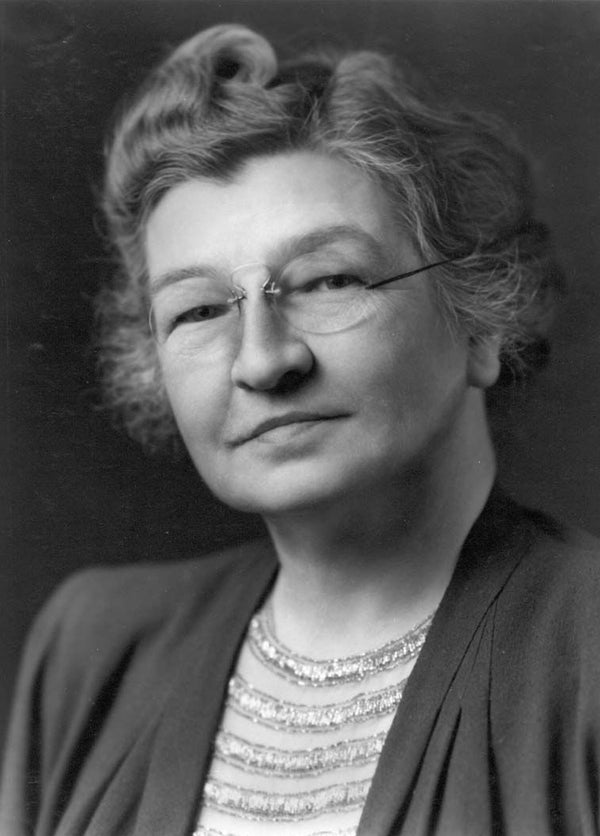
Edith Clarke (b. 1883 d. 1957) was a pioneer in electrical engineering, perhaps best known for developing mathematical methods that simplified how engineers characterized long power lines.
Clarke’s invention – the “Clarke Calculator” - greatly simplified calculations used to understand long transmission lines in the days before computers, allowing analysts to solve key equations ten times faster than previous methods.
When Clarke filed her patent application in 1921, engineers and analysts would assume that the capacity and inductance of short transmission lines were concentrated at isolated points along a power line (as opposed to being distributed uniformly along the line). According to Clarke, these assumptions were “not justifiable when the transmission line which is being investigated becomes comparatively long, say a few hundred miles” and led to significant errors in the calculations.
On supporting science journalism
If you're enjoying this article, consider supporting our award-winning journalism by subscribing. By purchasing a subscription you are helping to ensure the future of impactful stories about the discoveries and ideas shaping our world today.
According to Clarke, “if accuracy is desired in calculations for long [transmission] lines, it is absolutely necessary to take into consideration the uniformly distributed inductance and capacity in the line.” But, these calculations were complex and required significant man hours in the days before computers.
In response to this challenge, Clarke invented a graphical calculator for solving line equations involving hyperbolic functions. This calculator allowed engineering and analysts to more easily solve these equations and, in turn, more accurately characterize long transmission lines. The tool also supported Clarke’s work to gather data about the power grid and "can be seen as the first step toward “smart grid” technology according to the U.S. Department of Energy.
In 2015, Clarke was elected into the National Inventors Hall of Fame for her Clarke Calculator.

Photo: USPTO Publication US1552113 A (published September 1, 1925)