
This article was published in Scientific American’s former blog network and reflects the views of the author, not necessarily those of Scientific American
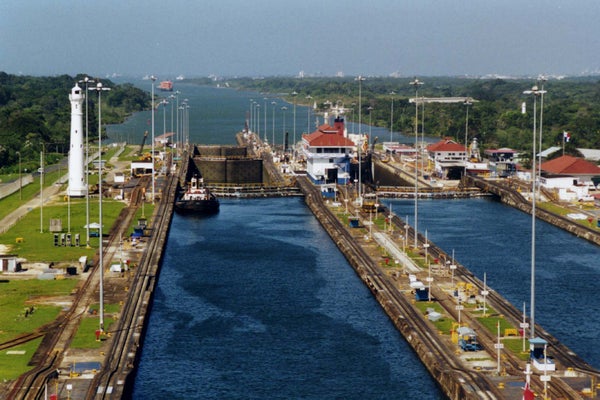
The Panama Canal can now accommodate 90% of the world’s liquefied natural gas (LNG) tankers, thanks to its recent expansion. According to the U.S. Energy Information Administration, the reduced travel times and transportation costs enabled by this expansion will have significant impacts on the LNG trade between the U.S. Gulf Coast and key Asian markets.
Prior to the expansion, the Panama Canal could accommodate only 6% of the world’s LNG tankers. But, thanks to new locks in the canal, vessels can now access a wider travel lane (180 feet across versus the previous 109 feet maximum). In turn, all but the largest of today’s LNG vessels will be able to travel through the canal.
In turn, LNG shipments from the U.S. Gulf Coast can now reach Japan in just 20 days. This travel time is 14-days shorter than for routes around the southern tip of Africa and 11-days less than routes via the Suez Canal. Voyages will also be shorter to South Korea, China, and Taiwan says the EIA, with significant corresponding cost reductions:
On supporting science journalism
If you're enjoying this article, consider supporting our award-winning journalism by subscribing. By purchasing a subscription you are helping to ensure the future of impactful stories about the discoveries and ideas shaping our world today.
“…the round trip voyage cost for ships traveling from the U.S. Gulf Coast and transiting the Panama Canal to countries in northern Asia is estimated to be $0.30/MMBtu to $0.80/MMBtu lower than transiting through the Suez Canal and $0.20/MMBtu to $0.70/MMBtu lower than traveling around the southern tip of Africa. Transiting the Panama Canal offers reduction in transportation costs to northern Asian countries such as Japan, South Korea, Taiwan, and China and may offer some minimal cost reductions to countries in southeast Asia (Malaysia, Thailand, Indonesia, and Singapore), depending on transit time.”
These shorter shipment times are particularly important because the combined demand for LNG in these four countries – Japan, South Korea, China, and Taiwan – account for almost two-thirds of global LNG imports.