
This article was published in Scientific American’s former blog network and reflects the views of the author, not necessarily those of Scientific American
This month, a start-up company called Hyliion that is looking to hybridize Class 8 trucks around the world raised $21 million in Series A funding.
We first met Hyliion here at Plugged Inback in 2015 when the then student-led start-up was awarded the U.S. Department of Energy Clean Energy Entrepreneurship prize at the 15th annual Rice Business Plan Competition in Houston. They would go on to win the grand prize at the Department of Energy’s National Clean Energy Business Plan Competition in Washington, DC.
Their Co-Founder, Thomas Healy, is a former race car driver who found his love for the track when he was just nine years old. With competitions around the country, he became quickly used to following 18-wheelers full of racing gear down long highways. After his parents gave him a hybrid Honda Civic for his off-track car at the age of sixteen, Healy began to wonder:
On supporting science journalism
If you're enjoying this article, consider supporting our award-winning journalism by subscribing. By purchasing a subscription you are helping to ensure the future of impactful stories about the discoveries and ideas shaping our world today.
“why aren’t tractor trailers using hybrid technology?”
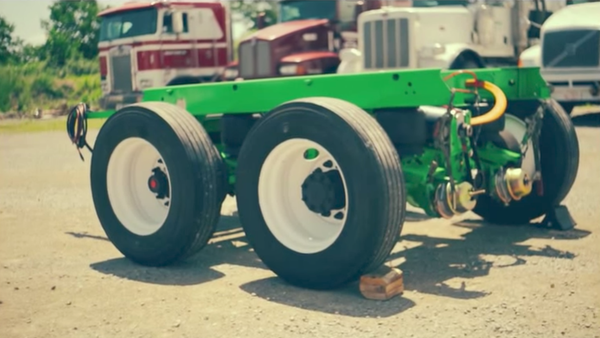
This is why, after entering college, Healy led the development of a slide-in suspension system for tractor-trailers that could reduce fuel use in these trucks by up to 30%. With an expected price tag of just $25,000, this fuel savings is all the more impressive.
The key to the Hyliion system is an intelligent electric drive axle that can be added to Class 8 trucks in order to reduce fuel use and its associated emissions. It can be retrofitted onto existing vehicles or installed into new ones. The original prototype of the system was built at an off-campus workshop near Carnegie Mellon University where Healy was studying for an engineering degree.

Healy standing in front of the Hyliion prototype, while showing its intended place on a trailer model. Credit: Melissa C. Lott 2015