
This article was published in Scientific American’s former blog network and reflects the views of the author, not necessarily those of Scientific American
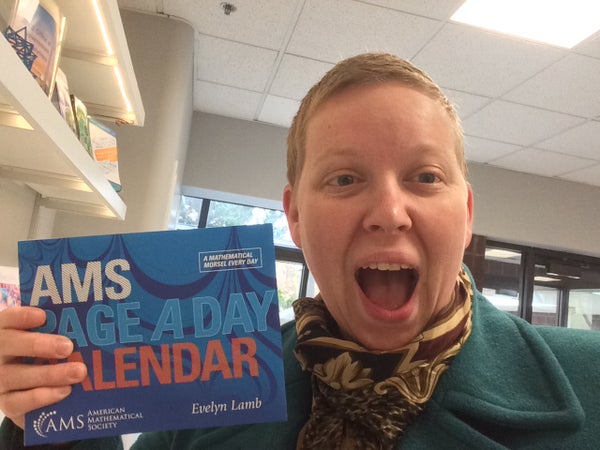
If you’re looking for a holiday gift for a mathematician, STEM student, teacher, or other math-interested person in your life (including yourself), I’ve got good news for you! I am excited to announce the availability of a product I am particularly proud of: the AMS Page-a-day calendar, published by the American Mathematical Society. You can find it in their online store. (Disclosure: This is not an affiliate link, but I earn royalties when someone buys this calendar.)
Almost two years ago, a friend asked if I knew of any page-a-day calendars about math. I poked around a bit and could find various page-a-day puzzle calendars but nothing that was quite what my friend had in mind. We went to the AMS to see if they would be interested in publishing a math calendar that didn’t focus on puzzles or arithmetic but on a much broader range of mathematical topics. Yes, puzzles are fun, but there’s a lot more to math than that. What about math-inspired art, math history and mathematicians, and all the weird and wonderful shapes and spaces mathematicians dream up? We wanted to make a math calendar that reflects the breadth of the subject and the diversity of the people who have done it, today and throughout history.
Much to our delight, the AMS said yes, and now this object exists in the world! I did most of the writing, but about 50 mathematicians, artists, and poets contributed images, poems, coloring pages, activities and puzzles for your enjoyment.
On supporting science journalism
If you're enjoying this article, consider supporting our award-winning journalism by subscribing. By purchasing a subscription you are helping to ensure the future of impactful stories about the discoveries and ideas shaping our world today.
You might know that I'm a total scrooge about holidays, especially Pi Day. Well, sometimes you’ve got to give the people what they want, and the people want Pi Day! To make up for my former scrooginess, I put a bunch of them in the calendar, and I even included some other important holidays: Swiss Cheese Day, e Day, World Snake Day, the International Day of Sign Languages, and of course Constitution Day in Nepal, to name a few.
Math is done by people, so I made sure to include a lot of them. Sure, you’ll see Gauss, Euler, and Noether on the calendar, but you’ll also meet Anna Julia Cooper, Chuan-Chih Hsiung, Dattathreya Kaprekar, Graciela Salicrup, and no fewer than four Olgas. (Rejected subtitle for the project: Four Olgas, No Mercy.) You’ll learn about mathematics from every continent except Antarctica (get with it, penguins!) and from thousands of years of history. There are jokes, riddles, puns, and a few days where I’m just trolling you. Sorry about that. Feel free to send me a video of yourself throwing the calendar across the room on April 16.
The calendar is not specific to 2020. You can use it any year! If you’re stumbling on this post well after I wrote it in November 2019, you should still be able to enjoy it. It will still be a steadfast mathematical companion as you face whatever new year it is. You can even drill some holes in the top and put it on a couple of binder rings and start using it at any point in the year.
I’m not used to asking readers to pay money directly for my writing. I love that so much of my work is available for free for anyone with an internet connection. But I really am proud of this calendar, and I think anyone who is interested in any aspect of math will learn something from this calendar—and perhaps even be entertained in the process.