
This article was published in Scientific American’s former blog network and reflects the views of the author, not necessarily those of Scientific American
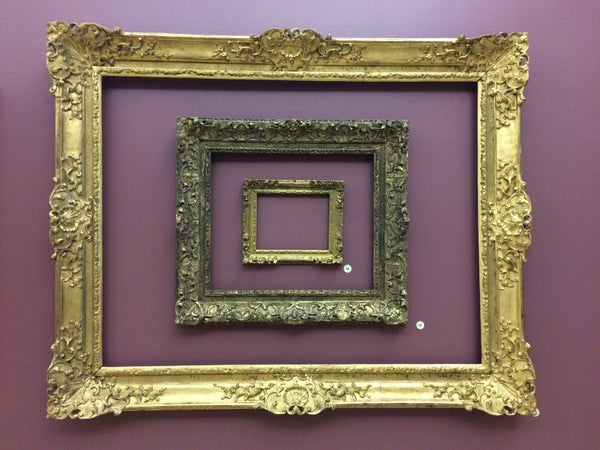
I walked into the next room of the museum and started laughing. Staring back at me were empty sets and sets containing the empty set. The Musée des Beaux Arts in Rouen, France has a small exhibit right now on frames: Histoire du Cadres, or History (or story) of Frames.

So many empty sets! Credit: Evelyn Lamb
I’m sure I was supposed to admire the workmanship, notice the dates on the frames, and see how they had changed through time, but all I could think about was nothing. Not nothing nothing like the nothingness in your mind when you stare out a train window on a long journey but the very present nothingness of the empty set in mathematics. (The post I wrote about the empty set last year is quite good, if I do say so myself. You should read it!)
On supporting science journalism
If you're enjoying this article, consider supporting our award-winning journalism by subscribing. By purchasing a subscription you are helping to ensure the future of impactful stories about the discoveries and ideas shaping our world today.
As I wrote last year, “The most glamorous thing about the empty set is probably the way you can use it to create something from nothing.” To do that, mathematicians literally build the whole numbers up from the empty set. The empty set itself is 0, and the set containing the empty set is 1. That’s right, the set containing the empty set is different from the empty set. Then you keep adding on: the set containing (the set containing the empty set and the set containing the set containing the empty set) is the number 2. The Histoire du Cadres exhibit did not have any frames that represent the number 2, but by taking a picture, I framed it myself.

An artist's interpretation of the number 2. Credit: Evelyn Lamb
While the exhibit lacked picture frame representations of large integers, it did give me an opportunity to ponder the empty set as an artistic experience. When I was writing my last post, I talked with James Madison University mathematician Laura Taalman about the empty set, and she said something to the effect of, “An empty meal would not just be a time during the day when you weren’t eating. You would sit down in front of a place setting, no one would bring you food, and then you’d get up and leave.” Likewise, this exhibit was the artistic parallel: you go to a museum, stand in front of a frame, and look at nothing.

Set theory for "0010." Credit: Evelyn Lamb
I know the creators of the exhibit did not intend to provoke mathematical thoughts, but that’s the great thing about art, isn’t it? I came to the museum with my life experiences, and they informed the way I perceived the art or lack thereof. The frame makers, exhibit curators, and I all contributed to my interpretation of the room. We created something—that is, nothing—together.